
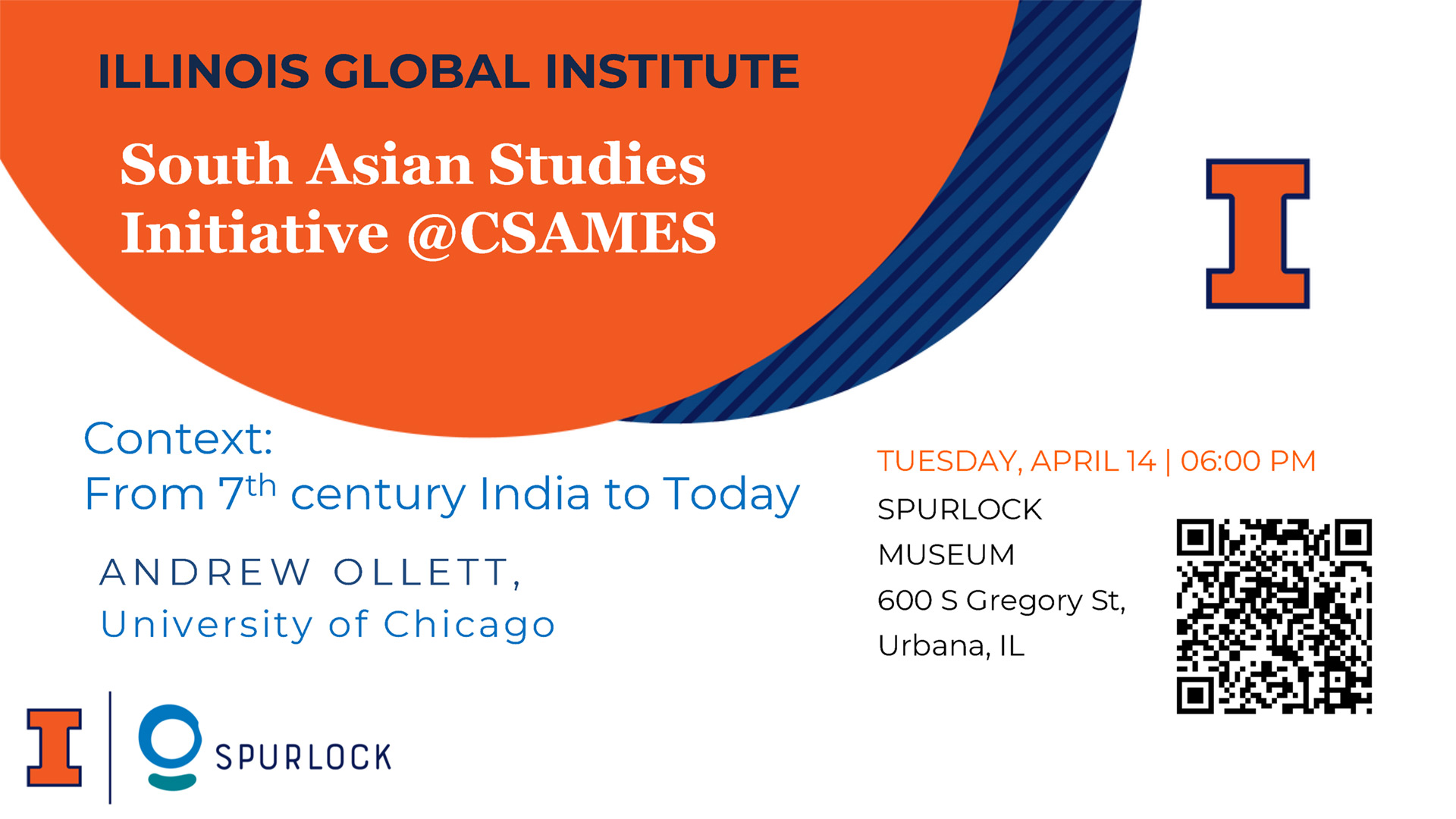
Talk: "Context, from 7th century India to today" by Andrew Ollett
- Event Date: Tuesday, April 14, 2026
- Time: 6:00 pm–7:30 pm (CDT)
- Location: Spurlock Museum, 600 S. Gregory St., Urbana, IL
An essential feature of modern language models is the ability to take context into account. A word’s meaning changes according to the words it accompanies. Although the implementation of this concept is very new, the concept itself is very old—and in fact the earliest systematic account of contextual meaning comes from India of the 7th and 8th centuries, when the philosopher Prabhākara formulated a theory he called “the expression of relational meanings” (anvitābhidhāna). This presentation will give an overview of Prabhākara’s theory, refined by the 8th/9th c. philosopher Śālikanātha, and its connections to ways of thinking about and modeling meaning in contemporary machine learning.
Sponsors: CSAMES, Spurlock Museum, and an endowment from Professor Emerita Rajeshwari Pandharipande.
About the Speaker
Professor Andrew Ollett (external link) studies the literary and intellectual traditions of South Asia, including works composed in Sanskrit, Prakrit, Apabhramsha, Kannada, and Chinese, mostly falling within the first millennium of the common era. His research has focused on the “question of language”: the availability and choice of certain languages for certain purposes, and the role of language in cultural production and change. His recent book publication includes The Mirror of Ornaments (Ala&ngdot;kāradappa&ndot;ō): A Prakrit Work of Poetics. Naples: Unior Press, 2025. (Università degli Studi di Napoli “L’Orientale” Series Minor) alongside many other article/journal publications.
Contact
For further information on this event, contact Rini Bhattacharya Mehta at rbhttchr@illinois.edu (email link).
All are welcome. To request disability-related accommodations for this event, please contact Brian Cudiamat at cudiamat@illinois.edu (email link) or (217) 244-5586.