Business Advertisement Card: "Stibbs & Martel, Clothiers & Tailors"

1972.21.0184
Thumbnail of Business Advertisement Card: "Stibbs & Martel, Clothiers & Tailors" (1972.21.0184)

Detailed Images

Basic Information

Artifact Identification Business Advertisement Card: "Stibbs & Martel, Clothiers & Tailors"   (1972.21.0184)
Classification/
Nomenclature
  1. Communication Artifacts
  2. :
  3. Advertising Media
  4. :
  5. N/A
Artist/Maker Unknown
Geographic Location
Period N/A
Date 19th – 20th century CE
Culture Euro - American
Location Not on Exhibit

Physical Analysis

Dimension 1 (Width) 8.7 cm
Dimension 2 (Height) 5.2 cm
Dimension 3 (Depth) <0.1 cm
Weight 1 g
Measuring Remarks N/A
Materials Paper, Pigment--Ink
Manufacturing Processes Printed

Research Remarks

Description

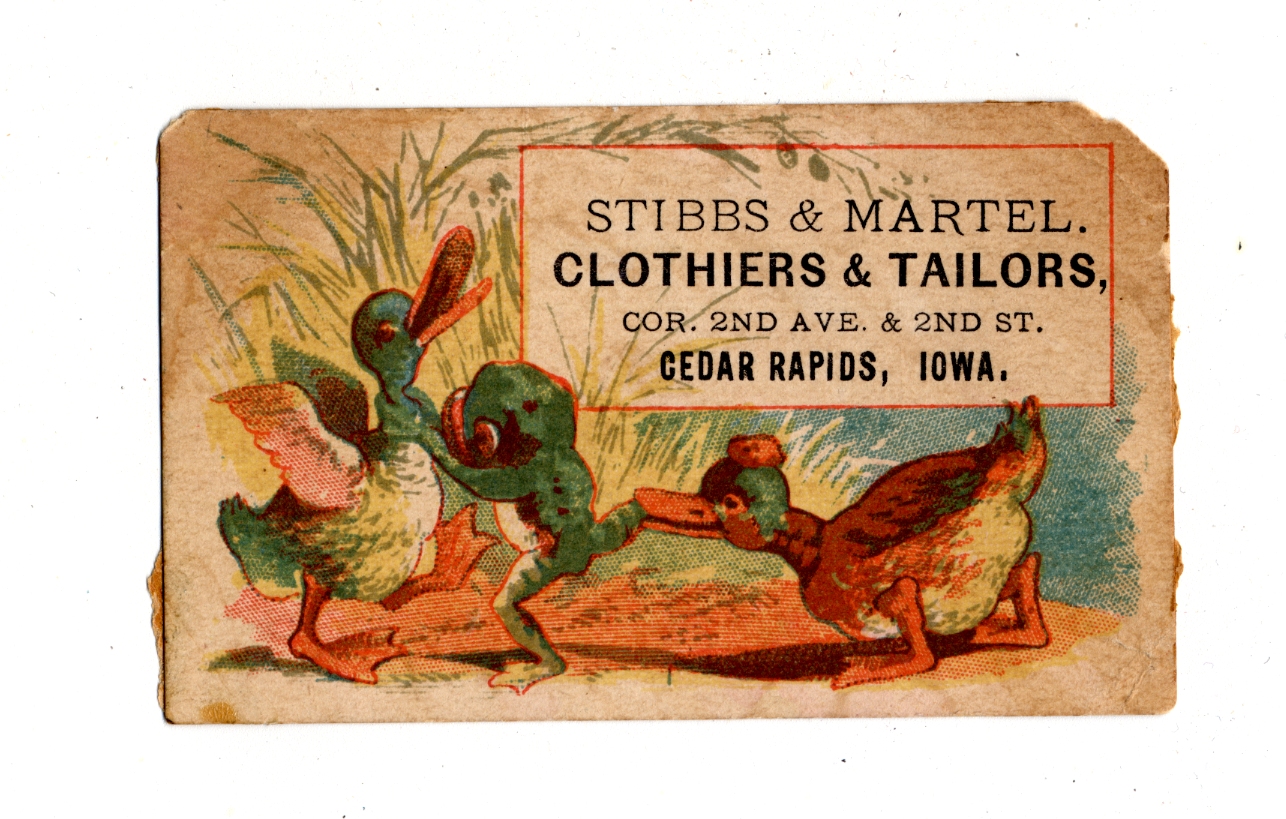
Many American advertising cards in the nineteenth century displayed a variety of visual and rhetorical themes to foster the attention of potential consumers. The appealing elements these cards displayed convinced the public that these easily disposable ephemera pieces were worthy of preservation. In this card for Stibbs & Martel Clothiers & Tailors, two advertising tropes which can be observed are eye-catching design features and the inclusion of animals.

Printed trade cards which featured appealing designs and imagery were more likely to be recognized by the American public and, therefore, generate brand recognition for the
producing company. Scenes with exotic, eye-catching, and even fantastical qualities were often implemented into these cards. This portrayal was meant to suggest that the advertised product, as opposed to similar items from other brands, was of high quality and perhaps even supernatural in its effectiveness. This card shows two ducks and a frog attacking one another to catch the eye of consumers as well as generate curiosity about what unique items the advertiser could offer.

American advertisers often included animals in their trade cards to charm and increase
consumer patronage. Producers were particularly incentivized to make their advertisements visually appealing to children since younger audiences tended to collect and disseminate trade cards to their parents. This card demonstrates this trend by showing two ducks and a frog, a curious image which helps to generate favorable attention from consumers.

Published Description N/A
Bibliography

“A Short History of Trade Cards,” Bulletin of the Business Historical Society 5, no. 3 (April
1931).

Berg, Maxine and Clifford, Helen, Selling Consumption in the Eighteenth Century: Advertising
and the Trade Card in Britain and France, The Journal of the Social History Society, (April 28,
2015).

Chase, Ernest D., The Romance of Greeting Cards, Rust Craft Publishers, 1956.

Jay, Robert, The Trade Card In Nineteenth-Century America, University of Missouri Press,
1987.

Lewis, John, Printed Ephemera: The Changing Uses of Type and Letterforms in English and
American Printing, W.S. Cowell Ltd., 1962.

Mehaffy, Marilyn Maness, Advertising Race/Raceing Advertising: The Feminine
Consumer(Nation), 1876-1900, Signs, 23, no. 1, The University of Chicago Press, 1997, 142-
143, https://www.jstor.org/stable/3175155.

Oatman-Stanford, Hunter, “Extreme Shipping: When Express Delivery to California Meant 100
Grueling Days at Sea,” Collectors Weekly, (June 2, 2016),
https://www.collectorsweekly.com/articles/when-express-delivery-meant-100-days-at-sea/.

Peterdi, Gabor, “Lithography” section of “Printmaking” article, Encyclopedia Britannica online,
2021, https://www.britannica.com/art/printmaking/Lithography.

Artifact History

Credit Line/Dedication Gift of Natalia M. Belting
Reproduction no

Contact

All information about our collection is constantly reviewed and updated. Please contact Dery Martínez-Bonilla, Registrar, if there is any information you are looking for that isn't currently online.