| Description |
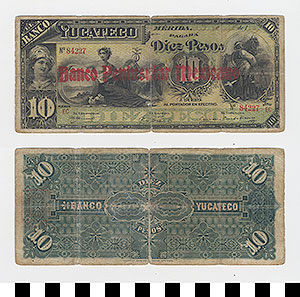
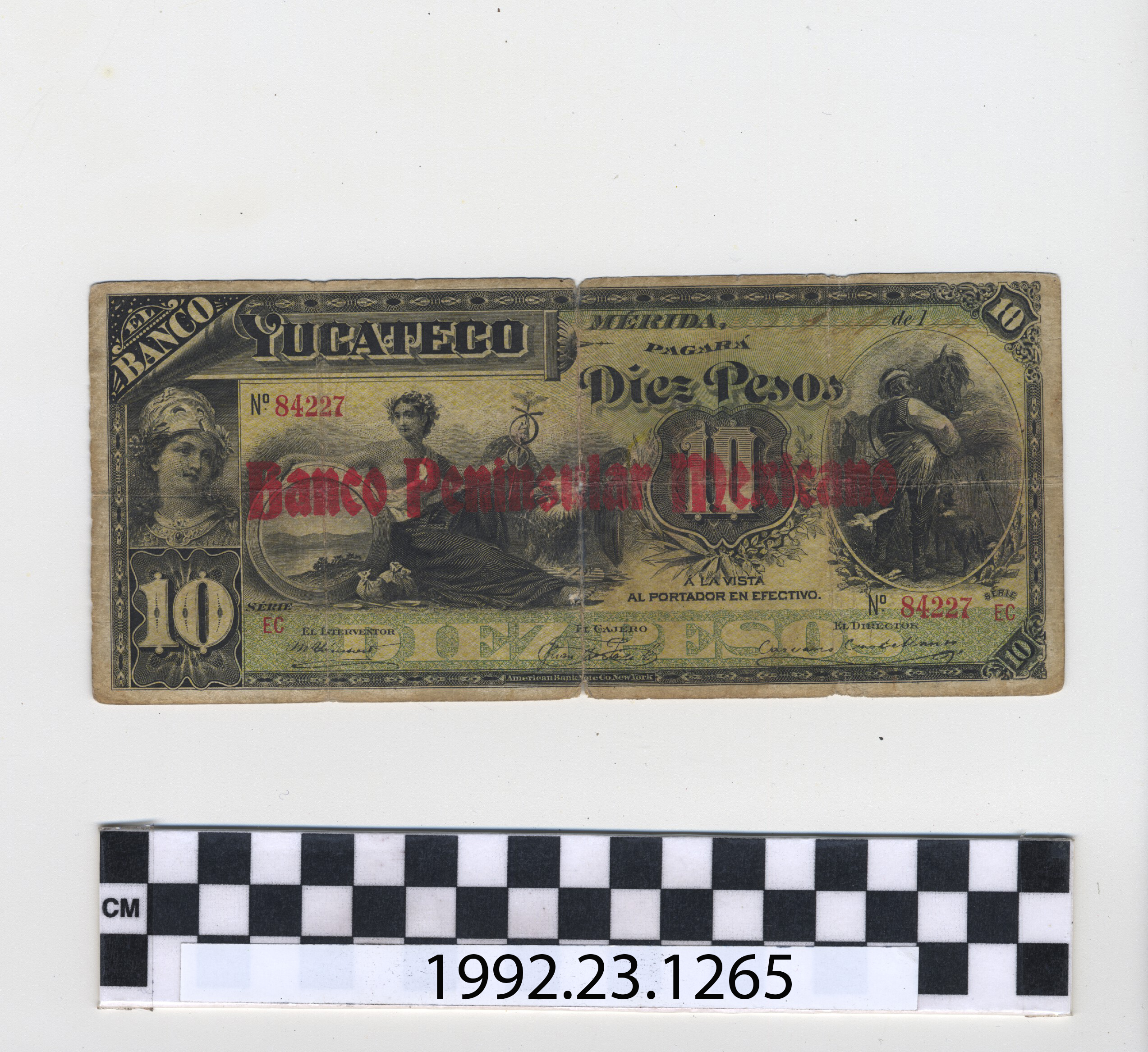
From left to right, Athena, allegory of commerce and a gaucho. Athena is known in Greek mythology as the goddess of wisdom, skill and war. Her equivalent in Roman mythology is Minerva, who presides over similar if not identical domains as those of her Greek counterpart. Typically, both goddesses are depicted with helmets and body armor.
In the off-center of the banknote is the allegory of commerce. This specimen's depiction of the metaphor as a woman is unusual given that commerce is a masculine idea in both Spanish linguistic and Greek/Roman mythological accounts. The figure in the banknote holds the caduceus, a winged staff with two snakes twirled around it. The Greek god of commerce, Hermes, and his Roman counterpart, Mercury, are often depicted with the caduceus. This is reason enough to believe that the woman figure is a stand-in for the Greek/Roman god of commerce.
A gaucho is the South American is similar to the western North American cowboy. Gauchos were once proficient, nomadic horsemen. They could be white, Black, or of mixed Black and white origin, although they were typically of mixed Native American and Spanish ancestry. The gaucho way of life is largely rooted in taking care of cattle. The man in the banknote above dons long trousers with accordion pleats. These pants, by the name of bombachas, are gathered at the ankles and slightly cover the tops of his high leather boots. This is typical of the gaucho costume. But given the gaucho's South American heritage, it's odd to see him on Mexican currency. One is to wonder why Mexico didn’t feature its own cowboy, the charro. Plausibly, the three figures on the banknote, when combined, tell of the country’s skillfulness (Athena) when it comes to agriculture (gaucho) and commerce (Ceres). |
| Bibliography |
“Athena.” Encyclopædia Britannica, July 3, 2023. https://www.britannica.com/topic/Athena-Greek-mythology.
Chiacchio, Angelo, and Ephemera Documentary. “The Argentinian Gaucho.” Google Arts & Culture. Accessed August 28, 2023. https://artsandculture.google.com/story/3QWRSuoN5ObeFg.
Cook, Jonathan. “Hermes the God of Commerce.” Medium, August 13, 2020. https://jonathanccook.medium.com/hermes-the-god-of-commerce-29acbf25d567
“Commerce.” English-Spanish Dictionary - WordReference.com. Accessed August 25, 2023. https://www.wordreference.com/es/translation.asp?tranword=commerce.
“Datos Relevantes Del Nuevo Billete de 1000 Pesos G.” Banco de México. Accessed August 25, 2023. https://www.banxico.org.mx/billetes-y-monedas/d/%7BE53145AB-3A19-397A-4876-FF0F45F2AC80%7D.PDF.
HarperCollins Publishers. “Caduceus.” American Heritage Dictionary. Accessed August 25, 2023. https://www.ahdictionary.com/word/search.html?q=caduceus
“Gaucho.” Diccionario del español de México. Accessed August 28, 2023. https://dem.colmex.mx/ver/gaucho.
“Gaucho.” Encyclopædia Britannica. Accessed August 28, 2023. https://www.britannica.com/topic/gaucho.
“Mexico 10 Pesos Paper Money Values.” Mexico 10 Pesos values and price guide. Accessed August 25, 2023. https://www.pmgnotes.com/priceguide/world-note-prices.aspx?deid=1767387&subcat=1889-1903-issue.
“Minerva.” Encyclopædia Britannica. Accessed August 25, 2023. https://www.britannica.com/topic/Minerva-Roman-goddess.
“PS-459.” Bank Note Museum. Accessed August 25, 2023. http://www.banknote.ws/COLLECTION/countries/AME/MEX/MEX-SPEC/MEXS0459.htm.
Rhys, Dani. “Minerva – Roman Goddess of Wisdom.” Symbol Sage, January 22, 2021. https://symbolsage.com/minerva-roman-goddess/.
Wasson, Donald L. “Mercury (Deity).” World History Encyclopedia, November 2018. https://www.worldhistory.org/Mercury_(Deity)/.
Webteam@eso.org. “Mercury and Mythology.” European Southern Observatory, May 7, 2003. https://www.eso.org/public/outreach/eduoff/vt-2004/mt-2003/mt-mercury-mythology.html
Zárate Toscano, Verónica, & Eduardo Flores Clair “La iconografía Del Papel Moneda En México, Siglos XIX Y XX”. Historias, n.º 104, June 28, 2021. https://revistas.inah.gob.mx/index.php/historias/article/view/16980. |