| Description |
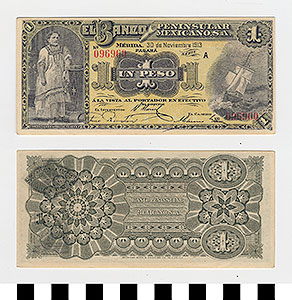
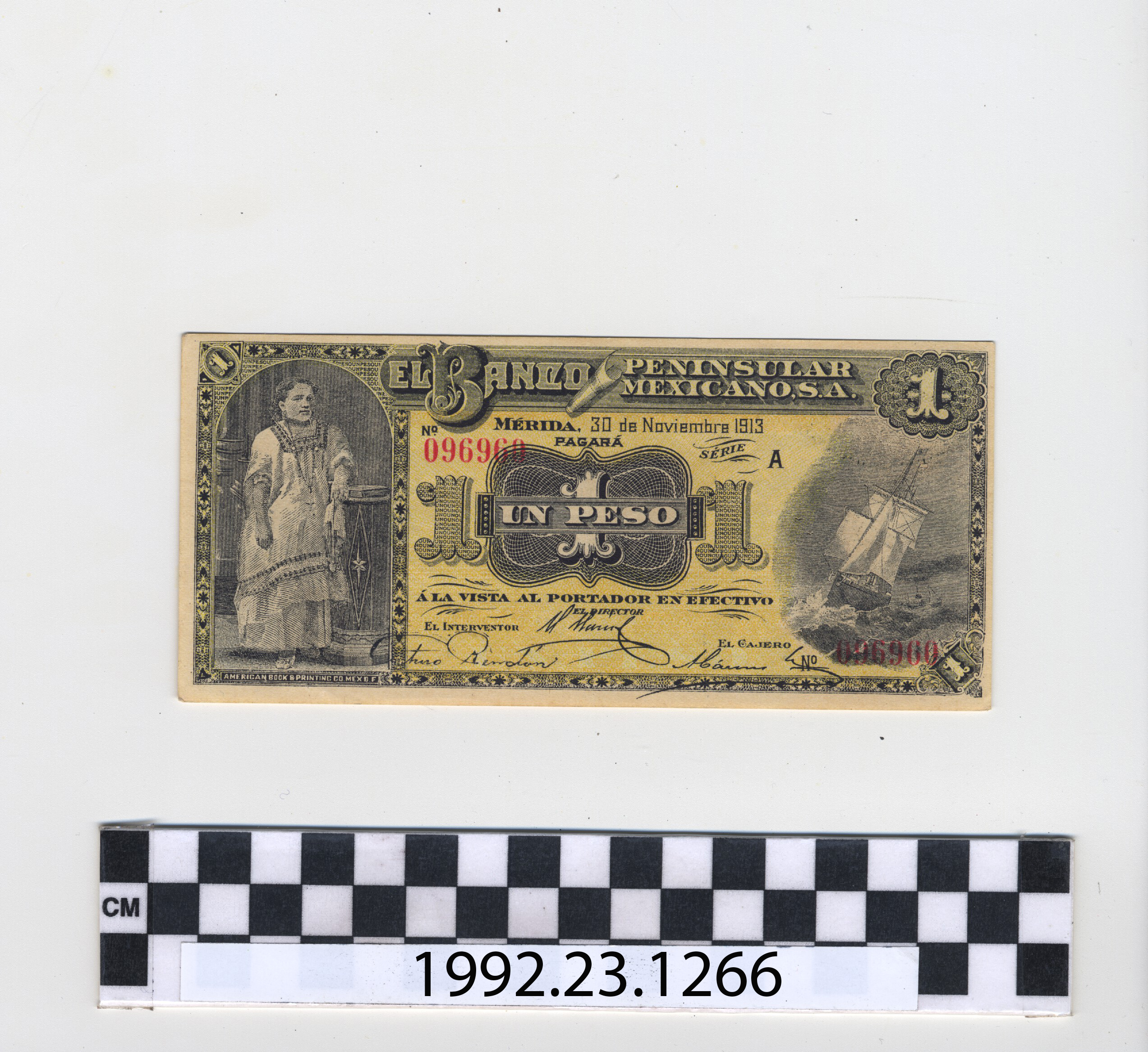
The state of Yucatán, Mexico is unique in that it has incorporated colonial Spanish influence but retained and emphasized its Mayan heritage. This is evident in its customs, cuisine, and its regional clothing, with the terno yucateco serving as a prime example. The dress is typical to Yucatán and considered one of the most simple and elegant ensembles in all of Mexico. It is no surprise that it is featured in Mexican currency.
The terno is made up of three garments. The first is the jubón, a kind of flap adjoined to the second piece, the hipil. The jubón creates a square neckline and leaves the neck exposed. It has two arm openings that simulate short sleeves, but leave most of the arms uncovered. The jubón is embroidered beautifully with multicolored flowers. Underneath this, one wears an hipil made of linen and silk cotton. It is the longest garment of the entire ensemble, and it is the one that many rural Yucatecan women wear on a daily basis. The fustán is a type of skirt tucked under the hipil at the waist and stops at the ankles. It is bordered with white cotton lace. The embroidery on the fustán and hipil’s hems match with those of the jubón, creating unison between the top and bottom garments. White shoes, a long golden rosary and earring set are worn to garnish the white ensemble. Multicolored flowers or ribbons adorn the hair, gathered in a tight bun at the nape of the neck. Based on the side the hair adornments are worn, one can tell a woman’s marriage status (left as single, right as married). Lastly, a shawl (rebozo) in the style of Santa Maria, Puebla.
The terno is exclusively worn in the fiestas de vaqueria and other festivities, occasionally in weddings. In this latter occasion, the terno lacks the colorful flower embroidery and is instead complemented with a long tulle veil that touches the ground. For other festivities, the terno displays its colorfully embroidered jubón and the fustán.
Side note! In the Yucatán peninsula, the terno’s long blouse goes by the name of hipil. In other parts of Mexico, like Oaxaca, it is known as huipil. The distinction between the hipil and the ensemble terno, was also used in colonial times to mark the difference in social castes between indigenous women who wore the hipil and mestiza (of mixed origin or from the Spanish peninsula) women who wore the terno. |
| Bibliography |
“El ‘Ipil’ y El Terno.” Diario Yucatán. Accessed August 17, 2023. https://web.archive.org/web/20070603010006/http://www.yucatan.com.mx/especiales/productos_yucatecos/terno.asp.
“Las diferencias entre el terno y el hipil - El yucateco #Yucatán.” YouTube, 2020. https://www.youtube.com/watch?v=7NuO8Ie5F_s&ab_channel=DiegoCuyt%C3%BAn.
Laureate International Universities, and Jésus Armando Puerto Caamal. LA JARANA DE YUCATÁN COMO HISTORIA Y TRADICIÓN | DOCUMENTAL. YouTube. YouTube, 2022. https://www.youtube.com/watch?v=mqOcdNsYqGA&ab_channel=ArmandoPuerto.
Nazar, Marcela. “Terno, Traje Típico de Yucatán.” topadventure.com, November 30, 2020. https://topadventure.com/cultura/Terno-traje-tipico-de-Yucatan-20201130-0004.html.
“Origen y Elementos de Los Trajes Típicos de Yucatán 2023.” Trajes Típicos de México, July 9, 2021. https://32trajestipicosdemexico.com/yucatan/.
Sayer, Chloë. Mexican costume. London: British Museum Publications, 1985.
“Terno Yucateco, Identidad y Encanto de La Península de Yucatán.” Los Cinco Soles, September 6, 2022. https://loscincosoles.com/es/terno-yucateco-identidad-y-encanto-de-la-peninsula-de-yucatan/?v=7516fd43adaa. |