Bank Note: Mexico, 1 Peso

1992.23.1481

Thumbnail of Bank Note: Mexico, 1 Peso (1992.23.1481)

Detailed Images

Basic Information

Artifact Identification Bank Note: Mexico, 1 Peso   (1992.23.1481)
Classification/
Nomenclature
  1. Communication Artifacts
  2. :
  3. Exchange Media
  4. :
  5. N/A
Artist/Maker Tip. v Lit. "La Moderna" - 58.303- Merida
Geographic Location
Period Mexican Revolution
Date November 20, 1914
Culture Mexican
Location Not on Exhibit

Physical Analysis

Dimension 1 (Length) 13.4 cm
Dimension 2 (Width) 6.0 cm
Dimension 3 (Depth) <0.1 cm
Weight <1 g
Measuring Remarks N/A
Materials Paper, Pigment--Ink
Manufacturing Processes Printed

Research Remarks

Description

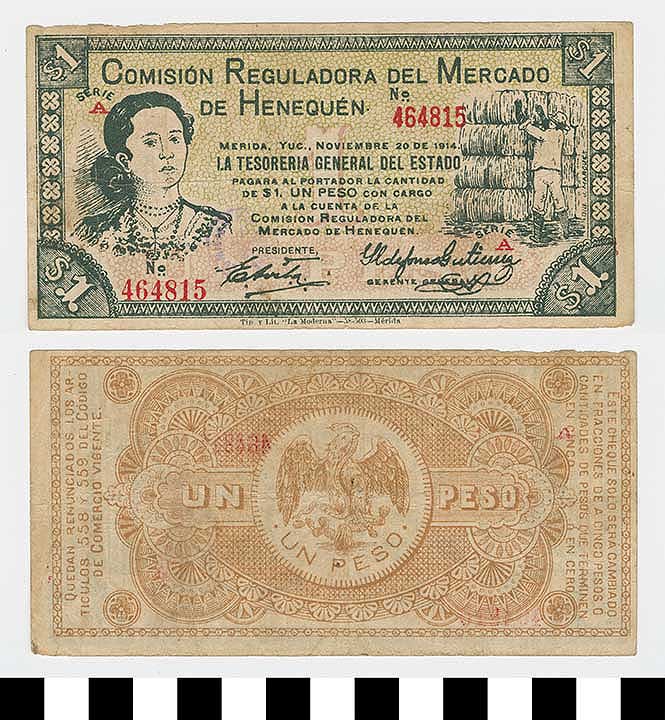
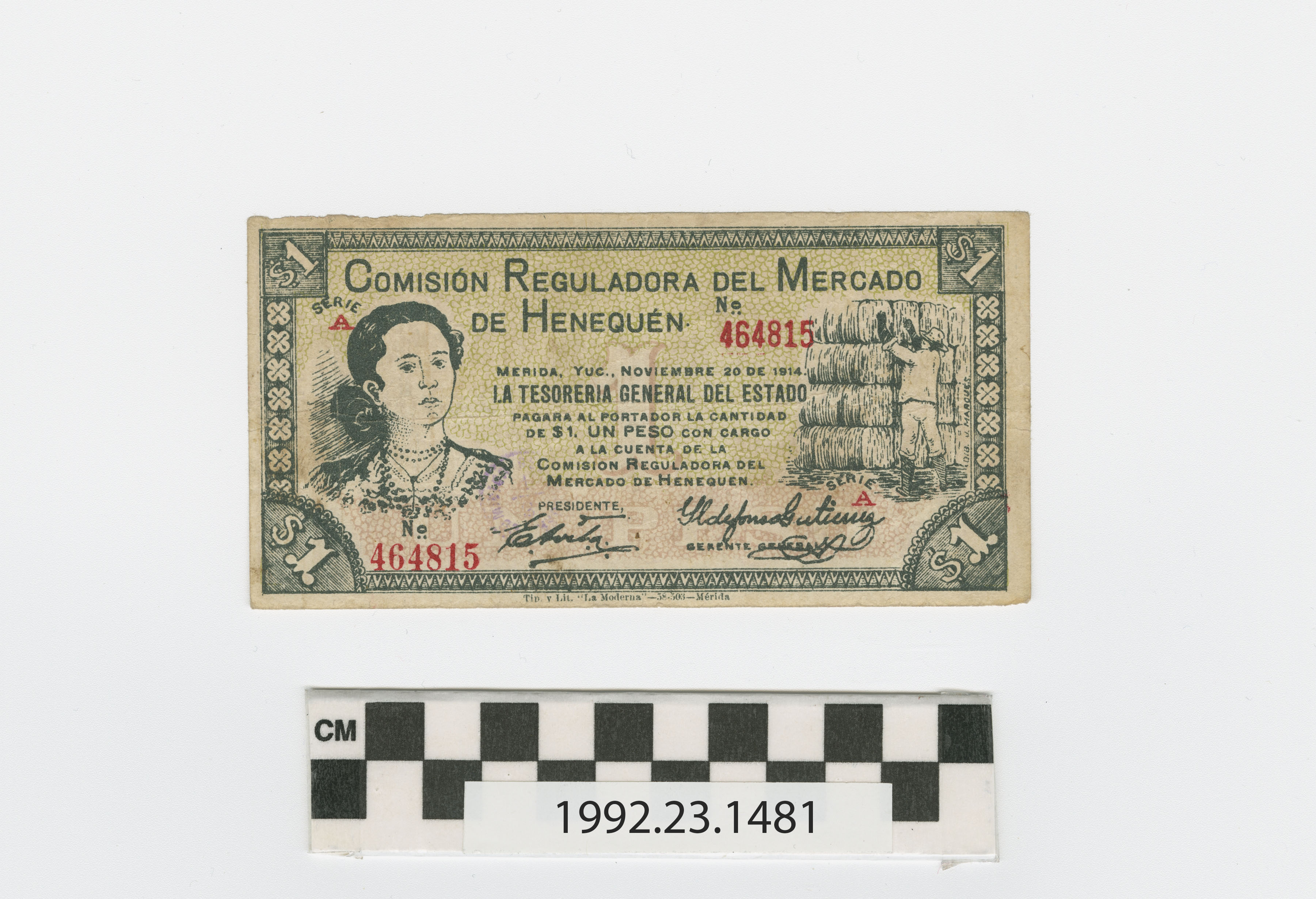
The portrait shown on the right is a depiction of a mestiza woman wearing the traditional dress of Yucatán. The state of Yucatán, Mexico is unique in that it has incorporated colonial Spanish influence but retained and emphasized its Mayan heritage. This is evident in its customs, cuisine, and its regional clothing, with the terno yucateco serving as a prime example. The dress is typical to Yucatán and considered one of the most simple and elegant ensembles in all of Mexico. It is no surprise that it is featured in Mexican currency. The terno made a separate appearance on a banknote issued by El Banco Peninsular Mexicano the same year as the bank note above in 1913. In the portrait above, the woman wears a long golden rosary. Flowers or ribbons adorn the hair, gathered in a tight bun at the nape of the neck. Based on the side the hair adornments are worn, one can tell a woman’s marriage status (left as single, right as married).

The Spanish arrival in Mexico, among many things, led to a boom in the economy. This was due in part to a fibrous plant native to the peninsula. Today it is referred to as ‘green gold’ and preceded the use of synthetic twine. Henequen, a staple in pre-Columbian Maya civilization, led to Yucatán becoming one of the richest states in Mexico in less than a half-century, from the late 1800s to early 1900s. Henequen price and production rose in the late 1800s to the point where the plant rivaled coffee exports. Its vital role in the economy must have led to its appearance on the bank note above, seeing as a worker is depicted next to bales of henequen. However, once the Mexican Revolution took root, the henequen industry quickly deteriorated. By enhancing labor rights, the revolution's leaders hoped to transform the country's elitist society. Since the industry had been founded on a system of strong elites and slave-like labor, the changes brought about by the revolution pushed the industry to become obsolete. Additionally, East Africa’s rapid production of sisal twine quickly began to drive sales of henequen down. In 1914, 97% of the world’s hard fiber was grown in Yucatán. Yucatán was generating less than a fifth of the world's hard fiber by 1938, eight years after East Africa surpassed Mexico in hard fiber production.

The combination of the region’s traditional dress and major export on the banknote most likely pay homage to its pre colonial roots.

Published Description N/A
Bibliography

“1 Peso, Yucatan.” Numista. Accessed August 17, 2023. https://en.numista.com/catalogue/note362621.html.

“1 Peso, Yucatan.” Numista. Accessed August 17, 2023. https://en.numista.com/catalogue/note224119.html.

Azteca Noticias. “La Última Hacienda Henequera.” YouTube, December 14, 2016. https://www.youtube.com/watch?v=5p5YXF1xg_Y&ab_channel=AztecaNoticias.

Fox, David J. “Henequen in Yucatan: A Mexican Fibre Crop.” Transactions and Papers (Institute of British Geographers), no. 29 (1961): 215–29. https://doi.org/10.2307/621253.

Nazar, Marcela. “Terno, Traje Típico de Yucatán.” topadventure.com, November 30, 2020. https://topadventure.com/cultura/Terno-traje-tipico-de-Yucatan-20201130-0004.html.

Rioux, Nyle Lucien. “The Reign of ‘King Henequen’: The Rise and Fall of Yucatán’s Export Crop from the Pre-Columbian Era through 1930.” Scholarly Communications and Research , 2014. https://scarab.bates.edu/honorstheses/106/.

“Terno Yucateco, Identidad y Encanto de La Península de Yucatán.” Los Cinco Soles, September 6, 2022. https://loscincosoles.com/es/terno-yucateco-identidad-y-encanto-de-la-peninsula-de-yucatan/?v=7516fd43adaa.

Zárate Toscano, Verónica, & Eduardo Flores Clair “La iconografía Del Papel Moneda En México, Siglos XIX Y XX”. Historias, n.º 104, June 28, 2021. https://revistas.inah.gob.mx/index.php/historias/article/view/16980.

Artifact History

Credit Line/Dedication Gift of Harlan J. and Pamela Berk
Reproduction no

Contact

All information about our collection is constantly reviewed and updated. Please contact Dery Martínez-Bonilla, Registrar, if there is any information you are looking for that isn't currently online.