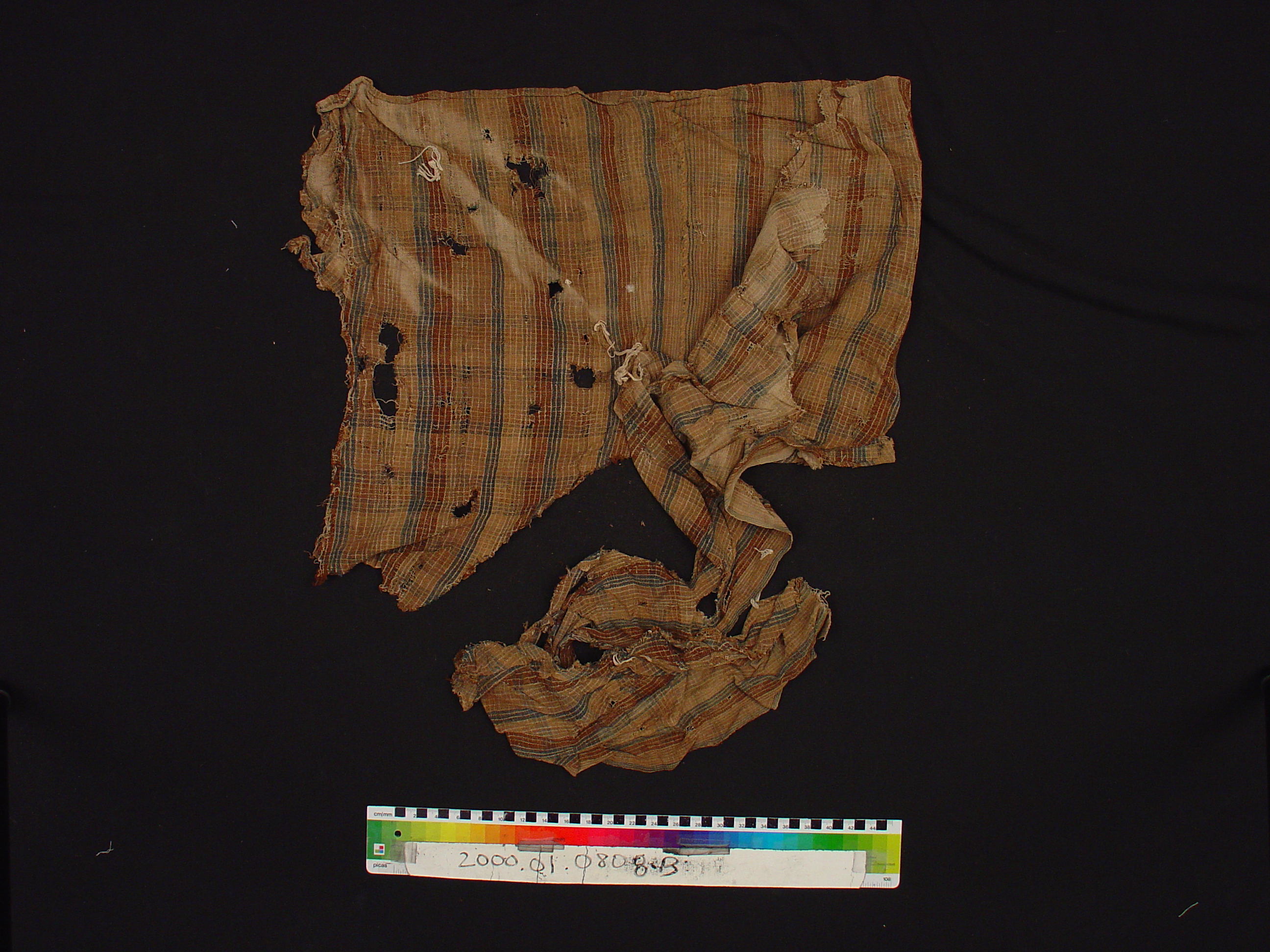
Textile

2000.01.0808D

Thumbnail of Textile (2000.01.0808D)

Detailed Images

Basic Information

Artifact Identification Textile   (2000.01.0808D)
Classification/
Nomenclature
  1. Unclassifiable Artifacts
  2. :
  3. N/A
  4. :
  5. N/A
Artist/Maker Unknown
Geographic Location
Period N/A
Date 100
Culture Tiahuanaco I
Location Not on Exhibit

Physical Analysis

Dimension 1 (Length) 67 cm
Dimension 2 (Width) 47 cm
Dimension 3 (Depth) .2 cm
Weight 123 g
Measuring Remarks N/A
Materials Textile, Pigment
Manufacturing Processes Dyeing, Weaving

Research Remarks

Description N/A
Published Description N/A
Bibliography

http://itrs.scu.edu/anthroweb2/036/PeruWebsite/maranga.html

http://www.saa.org/publications/saabulletin/16-1/SAA16.html: Arqueología del Peru , created by Lizardo Tavera Vega, at http://www.geocities.com/Athens/Acropolis/9071, represents for the Central Coast region what the Proyecto Ai Apaec is for the North Coast. Redesigned for its anniversary in November 1997, the site offers even more valuable content. Tavera clearly understands both the power of the medium and effective site design. Arqueología del Peru offers detailed discussions of nine archaeological sites near Lima: Cueva, Chilca, El Sol, La Luz, Maranga, El Paraíso, Pachacamac, and Pucllana. Each includes discussions of chronology, features, and site interpretation, as well as numerous photographs, maps, and plans. Online essays cover geography, the current state of Peruvian archaeology, early ceramics, Amazonian archaeology, and a biography of archaeologist Julio C. Tello. Additional pages offer brief illustrated descriptions of the Chancay, Ichmay, and Lima cultures, "U"-shaped temple complexes, and the Inka empire. Links to these are organized by hypertext in chronological charts. Also included are three thematic bibliographies on the subjects of Amazonia and the eastern Andes, Huaca Concha, and Pachacamac; text versions of three Andean myths; a page on archaeological patrimony documenting the destruction of ruins at Matkatampu and Huaca Concha as a result of Lima's urban sprawl; and an extensive photo gallery, with images of pottery from Cajamarca, Chavín de Huantar, and the Inka fortress of Sacsahuaman.

Artifact History

Credit Line/Dedication Transfer from Department of Anthropology, UIUC
Reproduction N/A

Contact

All information about our collection is constantly reviewed and updated. Please contact Dery Martínez-Bonilla, Registrar, if there is any information you are looking for that isn't currently online.