
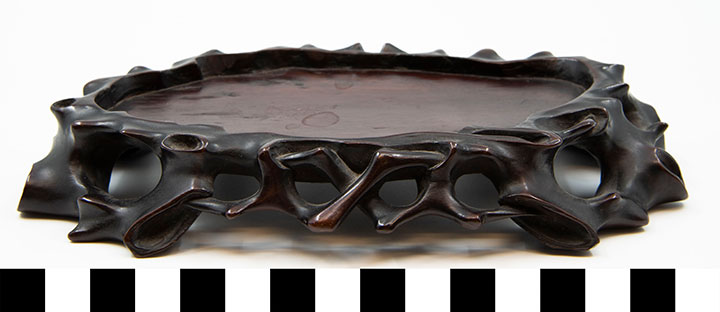
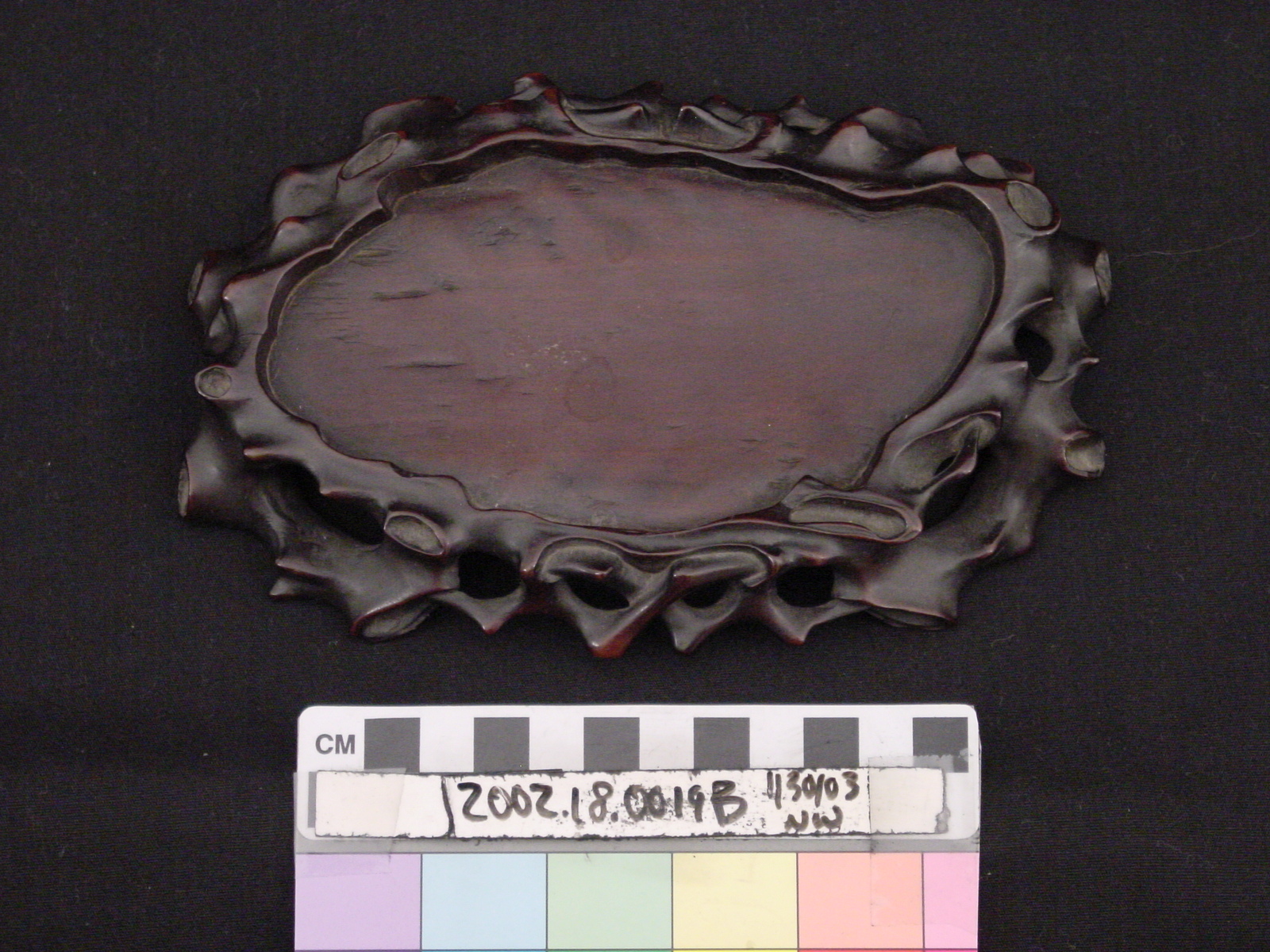
Figurine: Pudai (Budai, Hotei), God of Happiness and Laughter, Stand
2002.18.0019B
Detailed Images
Basic Information
| Artifact Identification | Figurine: Pudai (Budai, Hotei), God of Happiness and Laughter, Stand (2002.18.0019B) |
|---|---|
| Classification/ Nomenclature |
|
| Artist/Maker | Unknown |
| Geographic Location | |
| Period | Qing Dynasty (1644-1911) |
| Date | Late 18th - Early 19th Century |
| Culture | Chinese |
| Location | Not on Exhibit |
Physical Analysis
| Dimension 1 (Width) | 17.5 cm |
|---|---|
| Dimension 2 (Length) | 11.5 cm |
| Dimension 3 (Height) | 2.4 cm |
| Weight | 144 g |
| Measuring Remarks | N/A |
| Materials | Plant--Boxwood, Plant--Wood |
| Manufacturing Processes | Carved |
Research Remarks
| Description | This is the stand of a carved Lohan, likely Rahula, which was created during the Qing Dynasty (1644-1911). A Lohan is one of the 500 Buddhist disciples to achieve enlightenment. Wood, as the second of the five Chinese elements, is highly venerated as a material for decorative art. Due to this perception, artists frequently ornamented their wooden materials with images of mythical and / or religious meaning. Lacquerware was typically produced in government-sponsored workshops, though this was not always the case. In times of economic prosperity, the commercial workshops of southern China, particularly the southeastern provinces of the Song and Yuan periods (13th-14th century) and the late Ming era (1368-1644), were innovative in their approaches to creating lacquer items. Lacquer items from the Qing palace workshops were, at first, carved by craftsmen capable of overcoming the difficulties of lacquer carving due to their experience carving bamboo and ivory. However, the rapid political and economic decline of the Qing Dynasty following the reign of Qianlong (1735-1796) resulted in the closing down of many palace workshops, and the lacquer items made afterwards were fewer and had diminished in quality. |
|---|---|
| Published Description | N/A |
| Bibliography | Dursum, Brian A. et al. China’s Last Empire: The Art and Culture of the Qing Dynasty, 1644-1911. Coral Gables: Lowe Art Museum, 2014. |
Artifact History
| Credit Line/Dedication | Fred A. Freund Collection |
|---|---|
| Reproduction | No |
Contact
All information about our collection is constantly reviewed and updated. Please contact Dery Martínez-Bonilla, Registrar, if there is any information you are looking for that isn't currently online.