
Bitong, Brush Pot Lid
2003.14.0002B
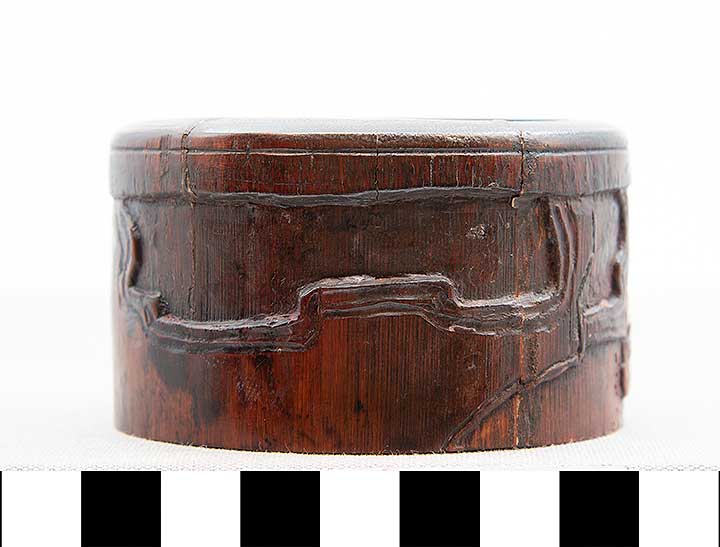
Basic Information
| Artifact Identification | Bitong, Brush Pot Lid (2003.14.0002B) |
|---|---|
| Classification/ Nomenclature |
|
| Artist/Maker | Unknown |
| Geographic Location | |
| Period | Qing Dynasty (1644-1911) |
| Date | Late 18th - early 19th century |
| Culture | Chinese |
| Location | Not on Exhibit |
Physical Analysis
| Dimension 1 (Diameter) | 7.2 cm |
|---|---|
| Dimension 2 (Height) | 4.1 cm |
| Dimension 3 (N/A) | N/A |
| Weight | 42 g |
| Measuring Remarks | N/A |
| Materials | Plant--Bamboo |
| Manufacturing Processes | Carved |
Research Remarks
| Description | This is the lid of a bitong (brush pot), a scholar's desk item of the Qing Dynasty (1644-1911). The concept of the "four treasures" (inkstone, ink, brush, and paper) of a scholar's study became an appreciated facet of interior design during the Song Dynasty (960-1279). Additional desk items which were appreciated for their function and beauty included brush pots, wrist rests, scroll pots, and desk screens. As this artifact is constructed from bamboo, a plant consisting of stalks that tend to flourish throughout winter, it can be symbolically associated with longevity. |
|---|---|
| Published Description | N/A |
| Bibliography | Cameron, Nigel. The Chinese Scholar's Desk. Hong Kong: FormAsia Books, 2003. |
Artifact History
| Credit Line/Dedication | Fred A. Freund Collection |
|---|---|
| Reproduction | No |
Contact
All information about our collection is constantly reviewed and updated. Please contact Dery Martínez-Bonilla, Registrar, if there is any information you are looking for that isn't currently online.