
Fan Box
2007.12.0003B
Detailed Images
Basic Information
| Artifact Identification | Fan Box (2007.12.0003B) |
|---|---|
| Classification/ Nomenclature |
|
| Artist/Maker | Unknown |
| Geographic Location | |
| Period | Qing Dynasty (1644-1911) |
| Date | 17th century |
| Culture | Chinese |
| Location | Not on Exhibit |
Physical Analysis
| Dimension 1 (Length) | 36 cm |
|---|---|
| Dimension 2 (Width) | 17.5 cm |
| Dimension 3 (Depth) | 8.5 cm |
| Weight | 687 g |
| Measuring Remarks | N/A |
| Materials | Textile, Animal--Tooth--Ivory |
| Manufacturing Processes | Embroidering, Carved, Drilling |
Research Remarks
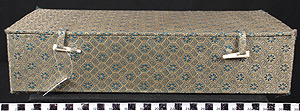
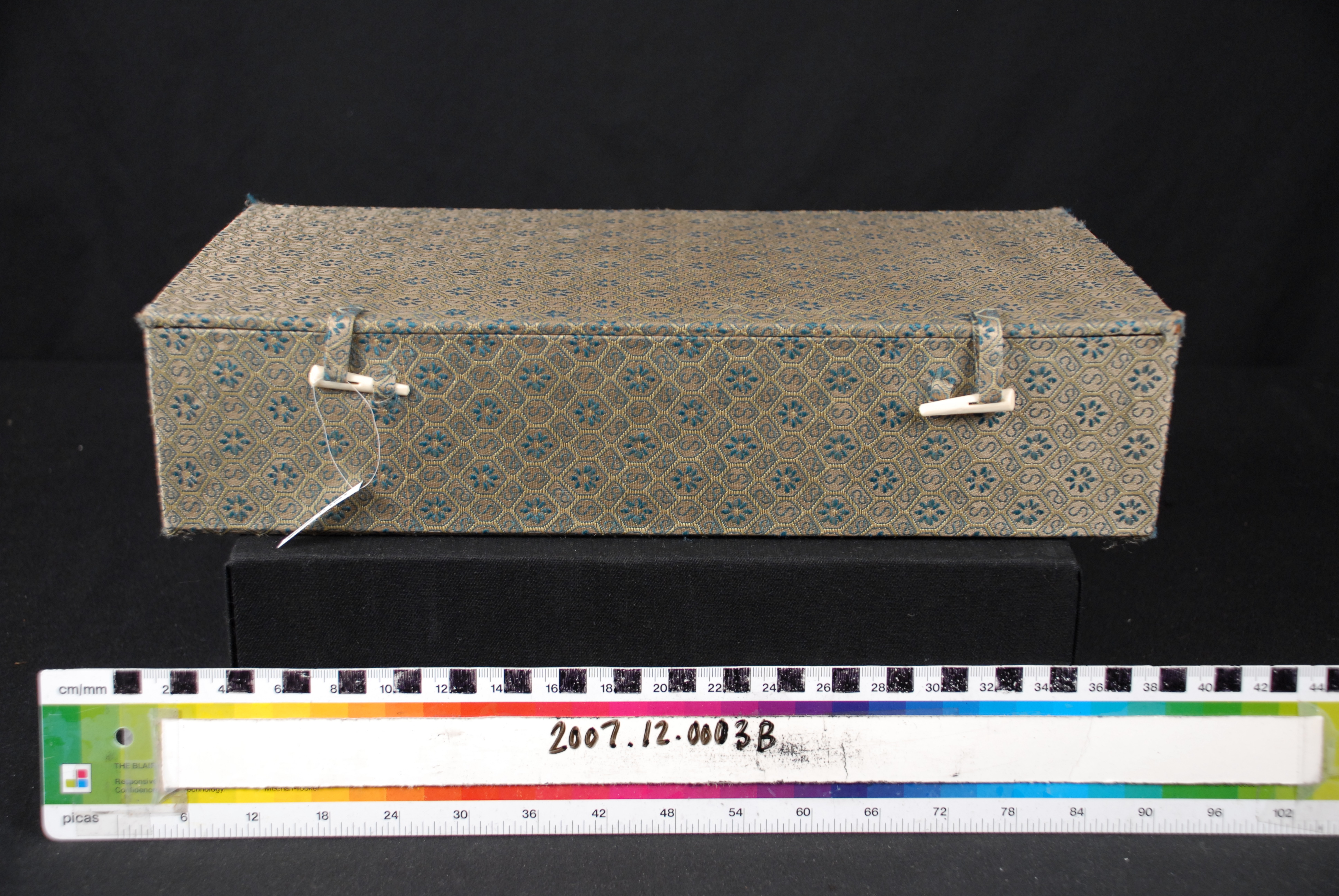
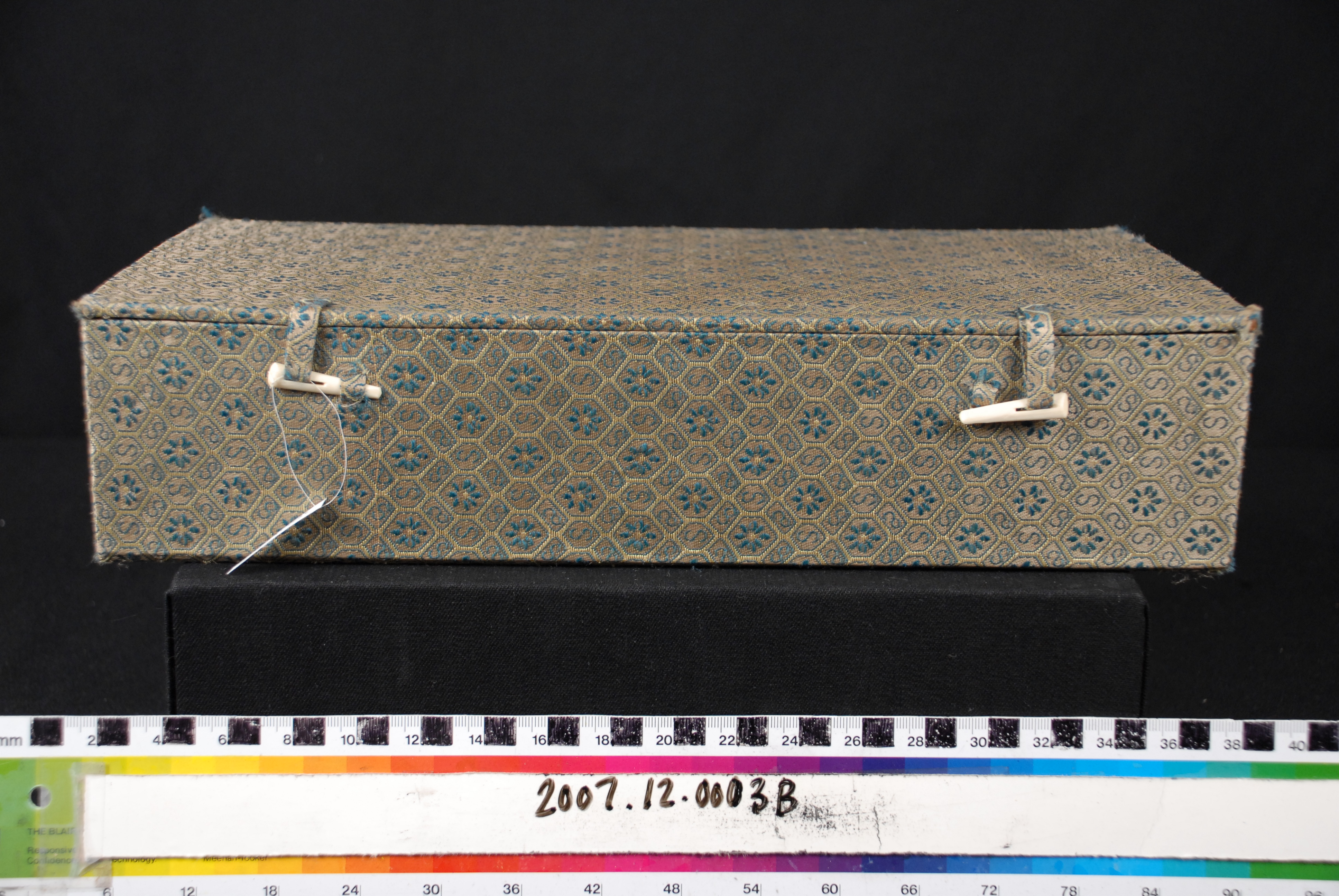
| Description | This is the box for a fixed fan (pien-mien) of the Qing Dynasty (1644-1911). Three types of Chinese fans evolved: the face cover fan (pien-mien), the ceremonial fan (T'uan-shan), and the folding fan (Che-shan). All three were used for social purposes, such as the pien-mien being a face cover to conceal emotions. Fan painting became an accepted and esteemed art around the Song Dynasty (960-1279). This particular fan is constructed both of bamboo and zitan wood, with the handle made from zitan and the fan made in the liu qing style of carving bamboo skin. Bamboo is a revered material for Chinese arts due to its association with longevity given that it is capable of flourishing throughout winter. Zitan is valued due to it being the hardest and heaviest of the hardwoods and a reliable material for Chinese decorative arts. |
|---|---|
| Published Description | N/A |
| Bibliography | Hutt, Julia. Understanding Far Eastern Art: A Complete Guide to the Arts of China, Japan and Korea - Ceramics, Sculpture, Painting, Prints, Lacquer, Textiles and Metalwork. New York: E.P. Dutton, 1987. |
Artifact History
| Credit Line/Dedication | Fred A. Freund Collection |
|---|---|
| Reproduction | N/A |
Contact
All information about our collection is constantly reviewed and updated. Please contact Dery Martínez-Bonilla, Registrar, if there is any information you are looking for that isn't currently online.