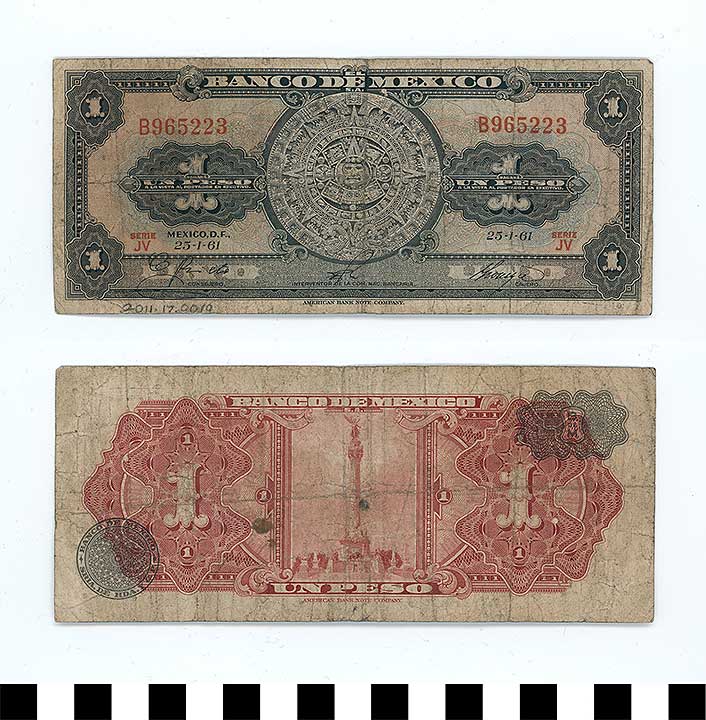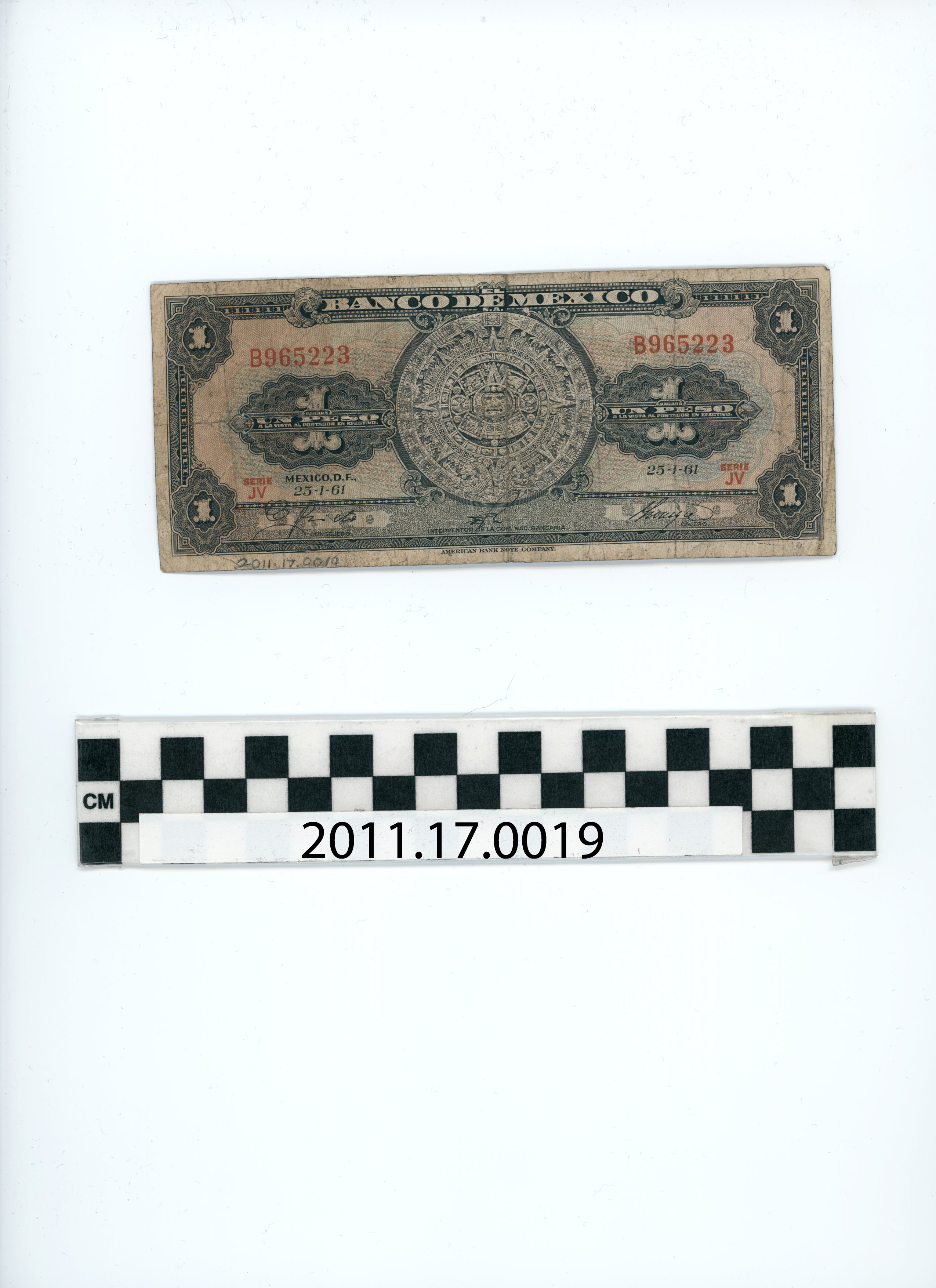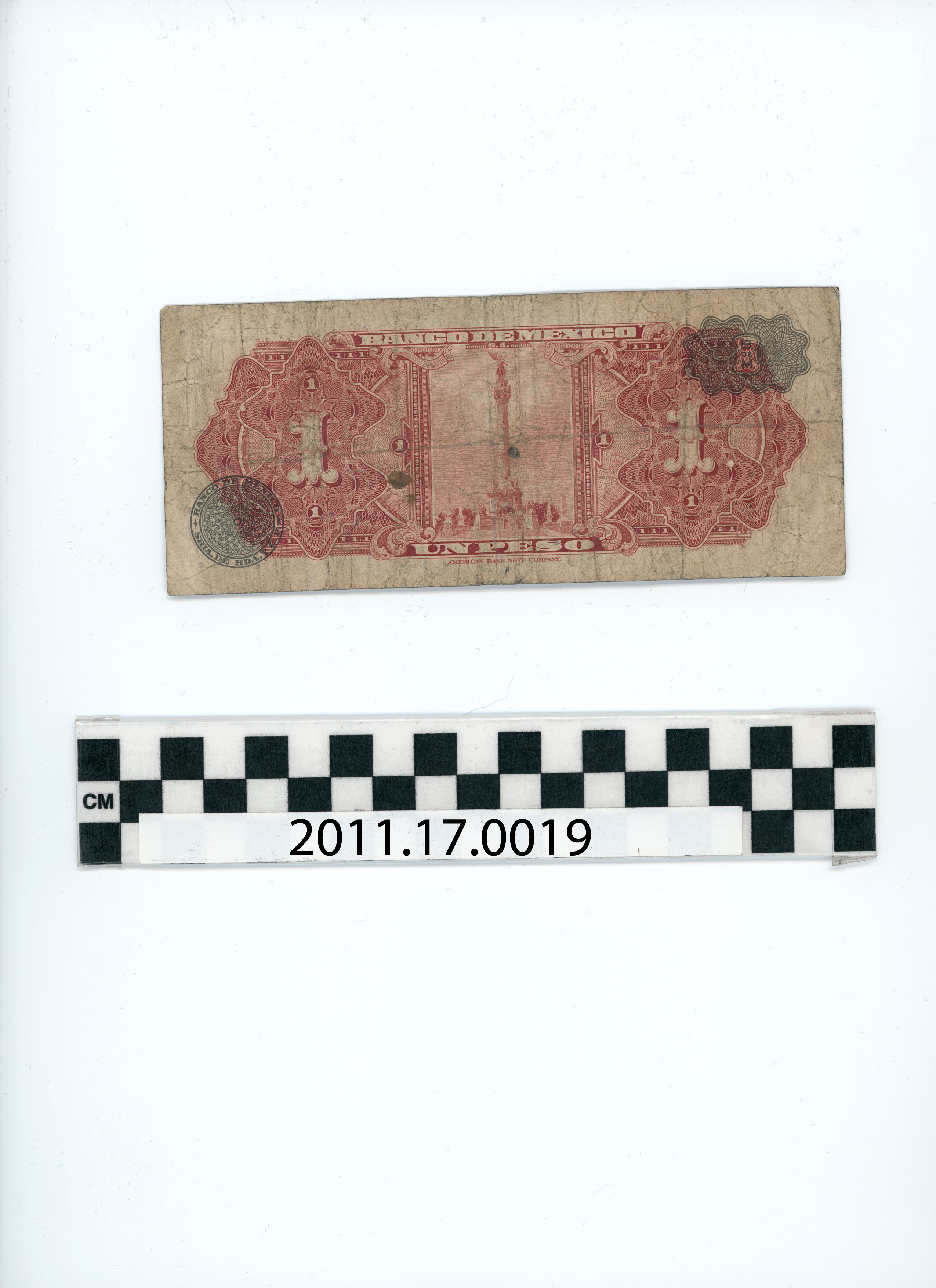
Bank Note: Mexico, 1 Peso

2011.17.0019

Thumbnail of Bank Note: Mexico, 1 Peso (2011.17.0019)

Detailed Images

Basic Information

Artifact Identification Bank Note: Mexico, 1 Peso   (2011.17.0019)
Classification/
Nomenclature
  1. Communication Artifacts
  2. :
  3. Exchange Media
  4. :
  5. N/A
Artist/Maker Unknown
Geographic Location
Period N/A
Date 1/25/1961
Culture Mexican
Location Not on Exhibit

Physical Analysis

Dimension 1 (Length) 15.47 cm
Dimension 2 (Width) 6.67 cm
Dimension 3 (Depth) <0.01 cm
Weight 1.09 g
Measuring Remarks N/A
Materials Paper, Pigment
Manufacturing Processes Printed

Research Remarks

Description

The Aztec calendar bank note, easily identified by its namesake’s rendering in the center, was in circulation from 1936 to 1978. The Sun Stone, another name for the Aztec calendar, is arguably the most well-known creation of the Mexica society. The Sun Stone was buried beneath what is now Mexico City's main square, or Zócalo, a few decades after the Spanish conquest. During renovations to the city's plumbing system in December 1790, the monument was rediscovered. Following its uncovering, the monarch of the time ordered the Calendar Stone be set on the Cathedral’s exterior wall and remained there until its relocation to the National Museum in 1885.

The sculpture's focal point is a representation of the sun god Tonatiuh. Although the monument displays the 20 days of the 260-day Mexica year, contemporary archaeologists think it was more likely used as a ceremonial basin or ritual altar for gladiatorial sacrifices than as a device for astronomy or astrology. Adapting the stone's geographic meaning, there is also a chance that its four points correspond to the four corners of the globe. From a political perspective, the stone may have been intended to represent Tenochtitlan as the center of the world and, hence, the seat of total authority. The Sun Stone most likely makes an appearance on this banknote to evoke the country’s historic memory, and pay homage to its pre colonial roots.

Published Description N/A
Bibliography

“1 Peso 1967 Mexico.” Notes Collection. Accessed August 21, 2023. https://notescollector.eu/pages/en/notes.php?noteId=859.

Cartwright, Mark. "The Aztec Calendar." World History Encyclopedia. Last modified April 25, 2016. https://www.worldhistory.org/article/896/the-aztec-calendar/.

Descubre Mexico. 15 Datos de la PIEDRA DEL SOL o Calendario Azteca que seguro desconocías. YouTube. YouTube, 2020. https://www.youtube.com/watch?v=HbqwmVEqqXE&ab_channel=DescubreMexico.

Forbes, Mia “Aztec Calendar: It Is More than What We Know.” TheCollector, August 18, 2020. https://www.thecollector.com/aztec-calendar/.

Museo Banco de México. “No. de Inventario: BIN1768,” Colección Numismática, accessed August 21, 2023, https://museobancodemexico.mx/LabNum/TemplateObjeto.html?BIN1768.

Sánchez, Julio. “Conoce El Único Billete de 1 Peso Que Ha Existido En México y Su Actual Valor.” El Sol de Puebla | Noticias Locales, Policiacas, sobre México, Puebla y el Mundo, December 11, 2021. https://www.elsoldepuebla.com.mx/finanzas/calendario-azteca-conoce-el-unico-billete-de-1-peso-que-ha-existido-y-su-actual-valor-7584419.html.

“The Aztec Calendar Stone.” Obsidian mirror-travels: The aztec calendar stone (Getty Research Institute). Accessed August 21, 2023. https://www.getty.edu/research/exhibitions_events/exhibitions/obsidian_mirror/aztec_calendar_stone.html.

“The Jaguar Cuauhxicalli.” Atlas Obscura, November 26, 2018. https://www.atlasobscura.com/places/jaguar-ocelotl-cuauhxicalli.

Zucker, Steven, and Beth Harris. The Sun Stone (The Calendar Stone). YouTube. YouTube, 2015. https://www.youtube.com/watch?v=Zn03u3-U1fk&ab_channel=Smarthistory.

Artifact History

Credit Line/Dedication Gift of James Sinclair and Elmer Uselmann
Reproduction No

Contact

All information about our collection is constantly reviewed and updated. Please contact Dery Martínez-Bonilla, Registrar, if there is any information you are looking for that isn't currently online.