
Search Results
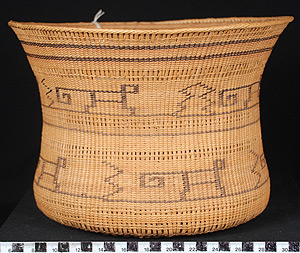
Woman’s Carrying Basket 2008.22.0285 (2008.22.0285)
27 x 23 x 19 cm (236 g)
Location: America, South: Venezuela
Period: 1970 - 1979
Classification/Nomenclature: Personal Artifacts : Personal Gear : Personal Carrying & Storage Gear
Period: 1970 - 1979
Classification/Nomenclature: Personal Artifacts : Personal Gear : Personal Carrying & Storage Gear
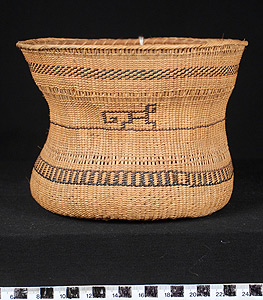
Woman’s Carrying Basket 2008.22.0286 (2008.22.0286)
20.3 x 17.5 x 14.5 cm (69 g)
Location: America, South: Venezuela
Classification/Nomenclature: Personal Artifacts : Personal Gear : Personal Carrying & Storage Gear
Classification/Nomenclature: Personal Artifacts : Personal Gear : Personal Carrying & Storage Gear
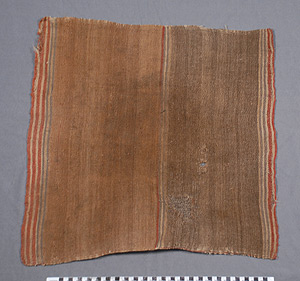
Mat2008.23.0001 (2008.23.0001)
60.1 x 58 x .2 cm (148 g)
Location: America, Central: Guatemala
Period: 20th century
Classification/Nomenclature: Furnishings : Floor Coverings
Period: 20th century
Classification/Nomenclature: Furnishings : Floor Coverings
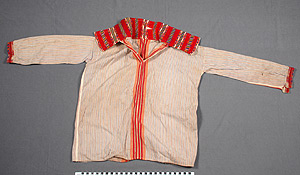
Man’s Shirt2008.23.0002 (2008.23.0002)
146.1 x 52.5 x .1 cm (336 g)
Location: America, Central: Guatemala: Huehuetenango Department: Todos Santos Cuchumatan
Period: 20th century
Classification/Nomenclature: Personal Artifacts : Clothing : Main Garments
Period: 20th century
Classification/Nomenclature: Personal Artifacts : Clothing : Main Garments
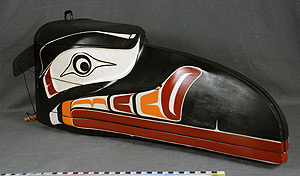
Transformational Mask: Frog and Raven 2008.24.0001 (2008.24.0001)
63.2 x 26.9 x 22.2 cm (2476 g)
Location: America, North: Canada: British Columbia, Northern Vancouver Island: Alert Bay
Period: Contemporary; 1997
Classification/Nomenclature: Communication Artifacts : Art
Period: Contemporary; 1997
Classification/Nomenclature: Communication Artifacts : Art
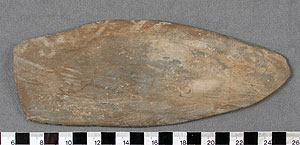
Stone Tool: Palette(?), Worked Stone 2009.01.0001 (2009.01.0001)
19.4 x 7.3 x 1 cm (220 g)
Classification/Nomenclature: Unclassifiable Artifacts
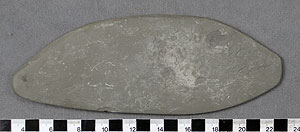
Stone Tool: Palette(?), Worked Stone2009.01.0002 (2009.01.0002)
19.6 x 7.1 x .9 cm (158 g)
Classification/Nomenclature: Unclassifiable Artifacts
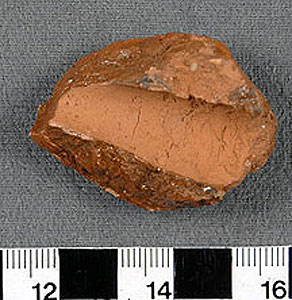
Body Sherd2009.01.0003 (2009.01.0003)
4.2 x 3.2 x 1.8 cm (16.365 g)
Classification/Nomenclature: Unclassifiable Artifacts
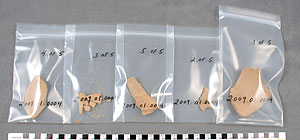
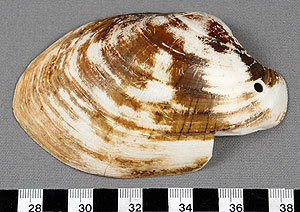
Reproduction Freshwater Mussel Spoon2009.01.0007 (2009.01.0007)
11 x 6.6 x 2 cm (40 g)
Classification/Nomenclature: Materials T&E : Food Service T&E : Eating & Drinking Utensils
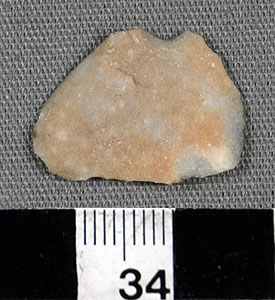
Raw Material: Stone2009.01.0008 (2009.01.0008)
2.1 x 1.5 x .16 cm (0.81 g)
Classification/Nomenclature: Unclassifiable Artifacts
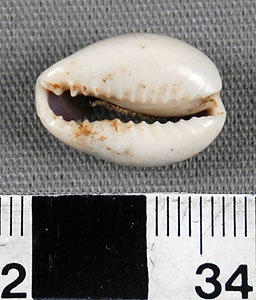
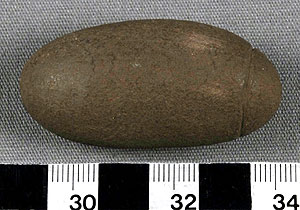
Raw Material: Stone2009.01.0011 (2009.01.0011)
5.13 x 2.6 x 2.2 cm (38 g)
Classification/Nomenclature: Unclassifiable Artifacts
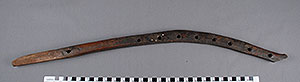
Wood Handle2009.01.0012 (2009.01.0012)
65.8 x 3 x 2 cm (225 g)
Classification/Nomenclature: Unclassifiable Artifacts

Arrow2009.01.0014 (2009.01.0014)
160.6 x 2.5 x 1.4 cm (45 g)
Classification/Nomenclature: Science & Technology T&E : Armaments : Edged Weapons
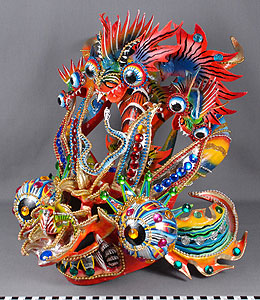
Mask: Diablada, Devil2009.02.0001 (2009.02.0001)
45 x 45 x 43 cm (2154 g)
Location: America, South: Bolivia: Oruro
Period: Contemporary; 2009
Classification/Nomenclature: Communication Artifacts : Ceremonial Artifacts : Holiday Objects
Period: Contemporary; 2009
Classification/Nomenclature: Communication Artifacts : Ceremonial Artifacts : Holiday Objects
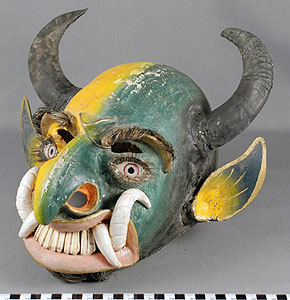
Mask: Diablada, Devil2009.02.0002 (2009.02.0002)
31 x 31 x 23 cm (1057 g)
Location: America, South: Bolivia: La Paz, Oruro
Period: 1940s - 1950s
Classification/Nomenclature: Communication Artifacts : Ceremonial Artifacts : Holiday Objects
Period: 1940s - 1950s
Classification/Nomenclature: Communication Artifacts : Ceremonial Artifacts : Holiday Objects
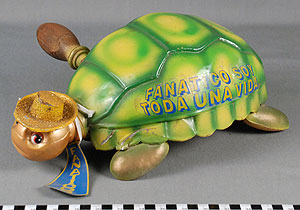
Turtle Matraca2009.02.0003 (2009.02.0003)
31.5 x 26 x 12 cm (529 g)
Location: America, South: Bolivia: Oruro
Period: 1990 - 2009
Classification/Nomenclature: Communication T&E : Musical T&E : Musical Instruments
Period: 1990 - 2009
Classification/Nomenclature: Communication T&E : Musical T&E : Musical Instruments
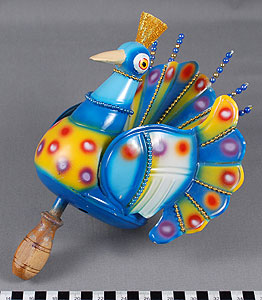
Peacock Matraca2009.02.0004 (2009.02.0004)
27 x 20.1 x 13.7 cm (293 g)
Location: America, South: Bolivia: Oruro
Period: 1990 - 2009
Classification/Nomenclature: Communication T&E : Musical T&E : Musical Instruments
Period: 1990 - 2009
Classification/Nomenclature: Communication T&E : Musical T&E : Musical Instruments
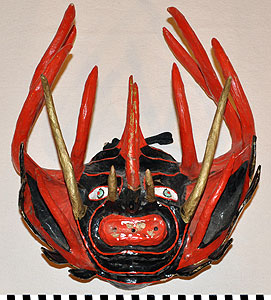
Mask: Diablada, Devil2009.03.0001 (2009.03.0001)
37 x 32 x 18 cm (680 g)
Location: America, South: Ecuador: Pillaro
Period: Contemporary; 2004
Classification/Nomenclature: Communication Artifacts : Ceremonial Artifacts : Holiday Objects
Period: Contemporary; 2004
Classification/Nomenclature: Communication Artifacts : Ceremonial Artifacts : Holiday Objects
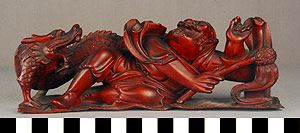
Carving: Lohan (Rakan) Nantimitolo2009.04.0001A (2009.04.0001A)
18 x 6.5 x 5.5 cm (227 g)
Location: Asia, East: China
Period: Late Qing Dynasty (1644-1911); late 19th century
Classification/Nomenclature: Communication Artifacts : Art
Description: This is a Chinese lacquer carving of Nantimitolo, an enlightened Buddhist disciple (Lohan) who is called the Taming Dragon Lohan due to him subduing the dragon guard of the dragon king in order to bring the Buddhist sutras back to Earth...
Period: Late Qing Dynasty (1644-1911); late 19th century
Classification/Nomenclature: Communication Artifacts : Art
Description: This is a Chinese lacquer carving of Nantimitolo, an enlightened Buddhist disciple (Lohan) who is called the Taming Dragon Lohan due to him subduing the dragon guard of the dragon king in order to bring the Buddhist sutras back to Earth...
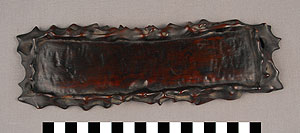
Carving: Lohan (Rakan) Nantimitolo, Base2009.04.0001B (2009.04.0001B)
23 x 7.3 x 2 cm (82 g)
Location: Asia, East: China
Period: Late Qing Dynasty (1644-1911); late 19th century
Classification/Nomenclature: Communication Artifacts : Art
Description: This is the base for a Chinese lacquer carving of Nantimitolo, an enlightened Buddhist disciple (Lohan) who is called the Taming Dragon Lohan due to him subduing the dragon guard of the dragon king in order to bring the Buddhist sutras back to Earth...
Period: Late Qing Dynasty (1644-1911); late 19th century
Classification/Nomenclature: Communication Artifacts : Art
Description: This is the base for a Chinese lacquer carving of Nantimitolo, an enlightened Buddhist disciple (Lohan) who is called the Taming Dragon Lohan due to him subduing the dragon guard of the dragon king in order to bring the Buddhist sutras back to Earth...
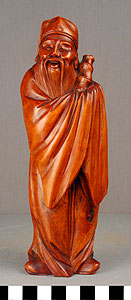
Carving: Su Tung-p’o, Chinese Writer2009.04.0002 (2009.04.0002)
19 x 6.3 x 4.7 cm (341 g)
Location: Asia, East: China
Period: Qing Dynasty (1644-1911); 18th - 19th century
Classification/Nomenclature: Communication Artifacts : Art
Description: The Spurlock museum holds a variety of Chinese lacquer figures created during the Qing Dynasty (1644-1911), and they serve as representations of regional beliefs and ethics, cultural figureheads, and the human condition...
Period: Qing Dynasty (1644-1911); 18th - 19th century
Classification/Nomenclature: Communication Artifacts : Art
Description: The Spurlock museum holds a variety of Chinese lacquer figures created during the Qing Dynasty (1644-1911), and they serve as representations of regional beliefs and ethics, cultural figureheads, and the human condition...
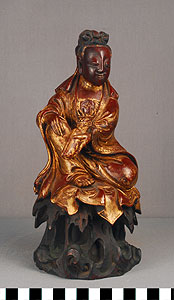
Carving: Guanyin (Kannon, Kuanyin, Avalokiteshvara)2009.04.0003 (2009.04.0003)
24 x 10.5 x 10.9 cm (636 g)
Location: Asia, East: China
Period: Qing Dynasty (1644-1911); 18th - 19th century
Classification/Nomenclature: Communication Artifacts : Art
Description: This is a Chinese boxwood carving of Guanyin (Kuan Yin), the Chinese name for the Bodhisattva Avalokitesvara...
Period: Qing Dynasty (1644-1911); 18th - 19th century
Classification/Nomenclature: Communication Artifacts : Art
Description: This is a Chinese boxwood carving of Guanyin (Kuan Yin), the Chinese name for the Bodhisattva Avalokitesvara...
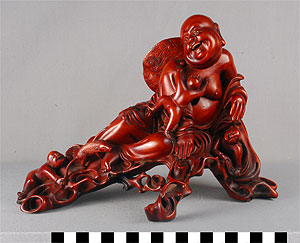
Carving: Pudai (Budai, Hotei) with Three Children and Rat2009.04.0004 (2009.04.0004)
25.5 x 18 x 15.5 cm (963 g)
Location: Asia, East: China
Period: Qing Dynasty (1644-1911); 19th century
Classification/Nomenclature: Communication Artifacts : Art
Description: Pudai, also known as "the laughing Buddha," is depicted as a large, half-naked figure who is said to have a carefree expression given that he has overcome the cares and anxieties which burden people...
Period: Qing Dynasty (1644-1911); 19th century
Classification/Nomenclature: Communication Artifacts : Art
Description: Pudai, also known as "the laughing Buddha," is depicted as a large, half-naked figure who is said to have a carefree expression given that he has overcome the cares and anxieties which burden people...
Search Examples
Explore More
Access the public portions of the catalog records for the approximately 50,000 cultural and ethnographic objects in the Museum's Artifact Collection.