
Search Results
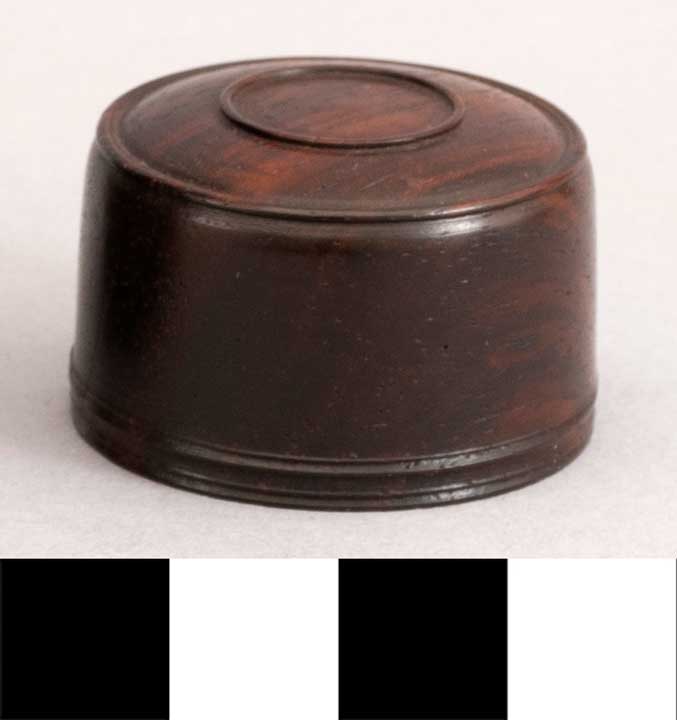
Tea Caddy Lid2004.13.0014B (2004.13.0014B)
11.4 x 5 x 3.1 cm (260 g)
Location: Asia, East: China
Period: Qing Dynasty (1644-1911); 18th century
Classification/Nomenclature: Materials T&E : Food Processing & Preparation T&E : Food Storage Equipment
Description: This tea caddy lid is made from gnarled rootwood and resembles the brush pots used for the Chinese scholar's desk...
Period: Qing Dynasty (1644-1911); 18th century
Classification/Nomenclature: Materials T&E : Food Processing & Preparation T&E : Food Storage Equipment
Description: This tea caddy lid is made from gnarled rootwood and resembles the brush pots used for the Chinese scholar's desk...
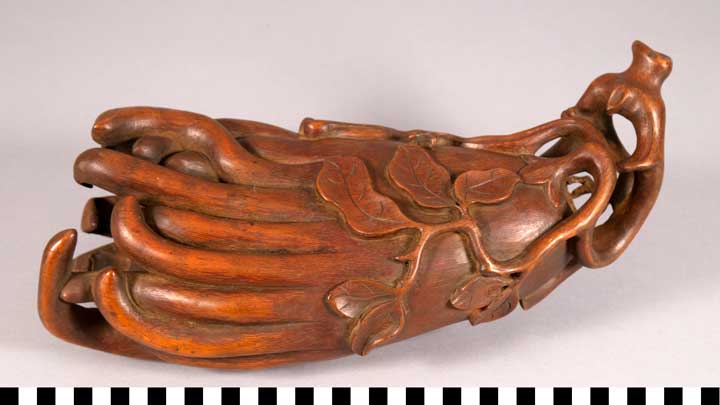
Carving: Finger Citron (“Buddha’s Hand”)2004.13.0015 (2004.13.0015)
36.5 x 15.5 x 14 cm ( g)
Location: Asia, East: China
Period: Qing Dynasty (1644-1911); 19th century
Classification/Nomenclature: Communication Artifacts : Art
Description: This is a carving of a Chinese finger citron, also known as Buddha's Hand (Fo Shou), which has a fragrant odor and is offered at the New Year's festival despite it being inedible...
Period: Qing Dynasty (1644-1911); 19th century
Classification/Nomenclature: Communication Artifacts : Art
Description: This is a carving of a Chinese finger citron, also known as Buddha's Hand (Fo Shou), which has a fragrant odor and is offered at the New Year's festival despite it being inedible...
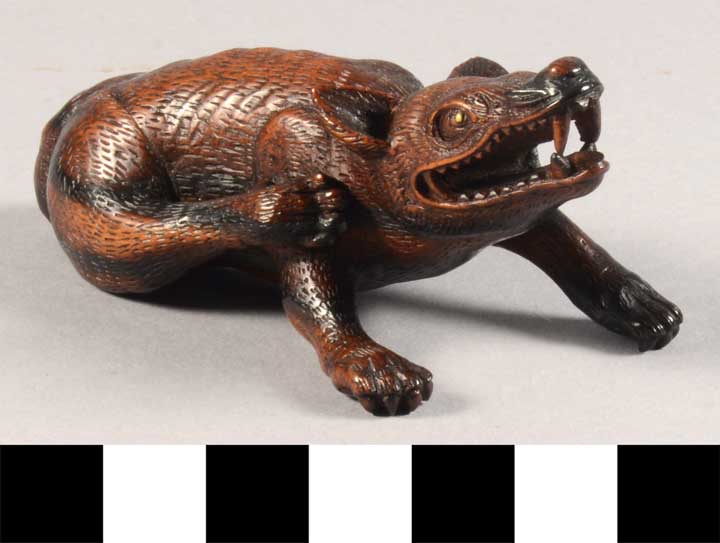
Okimono: Wolf2004.13.0016 (2004.13.0016)
8.5 x 3.6 x 3.4 cm (25 g)
Location: Asia, East: Japan
Period: Late Edo Period (1603-1868) or Early Meiji Period (1868-1912); 19th century
Classification/Nomenclature: Communication Artifacts : Art
Description: This is a Japanese okimono of a wolf. This piece is interesting in that it may also serve as a netsuke, a toggle which holds the cord attached to an inro or sagemono, given that the carving's partially opened mouth could store a section of rope or a knot...
Period: Late Edo Period (1603-1868) or Early Meiji Period (1868-1912); 19th century
Classification/Nomenclature: Communication Artifacts : Art
Description: This is a Japanese okimono of a wolf. This piece is interesting in that it may also serve as a netsuke, a toggle which holds the cord attached to an inro or sagemono, given that the carving's partially opened mouth could store a section of rope or a knot...
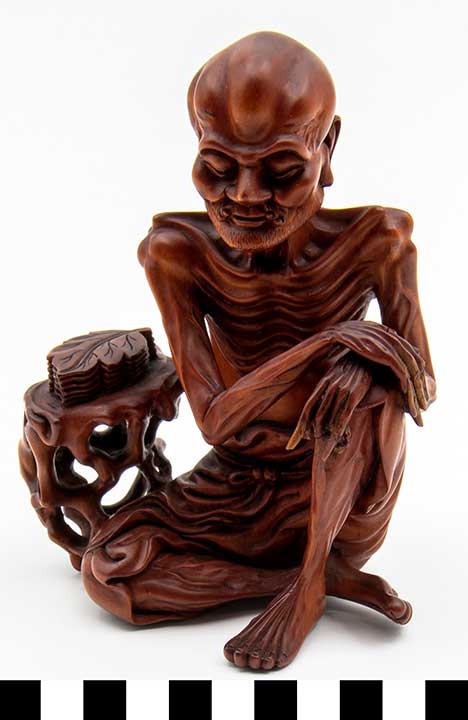
Figurine: Lohan (Rakan) (unnamed)2004.13.0017 (2004.13.0017)
10.5 x 9 x 7.4 cm (115 g)
Location: Asia, East: China
Period: Qing Dynasty (1644-1911); 18th Century
Classification/Nomenclature: Communication Artifacts : Art
Description: This is a boxwood lacquered carving of a an emaciated Lohan, one of the 500 Buddhist disciples to achieve enlightenment...
Period: Qing Dynasty (1644-1911); 18th Century
Classification/Nomenclature: Communication Artifacts : Art
Description: This is a boxwood lacquered carving of a an emaciated Lohan, one of the 500 Buddhist disciples to achieve enlightenment...
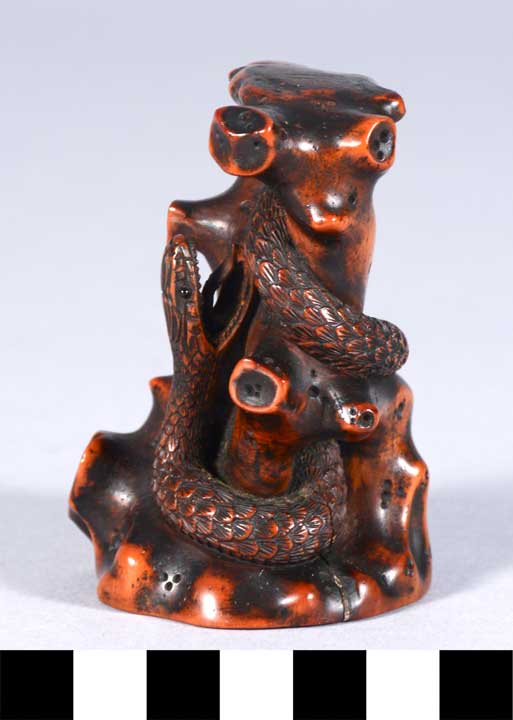
Okimono: Snake around a Tree Stump2004.13.0018 (2004.13.0018)
8.4 x 5 x 4.5 cm (66 g)
Location: Asia, East: Japan
Period: Late Edo Period (1603-1868) - Early Meiji Period (1868-1912); 19th century
Classification/Nomenclature: Communication Artifacts : Art
Description: This is a Japanese okimono of a snake wrapped around a tree stump. The snake is one of the twelve animals of the duodenary cycle and is often featured in Japanese art...
Period: Late Edo Period (1603-1868) - Early Meiji Period (1868-1912); 19th century
Classification/Nomenclature: Communication Artifacts : Art
Description: This is a Japanese okimono of a snake wrapped around a tree stump. The snake is one of the twelve animals of the duodenary cycle and is often featured in Japanese art...
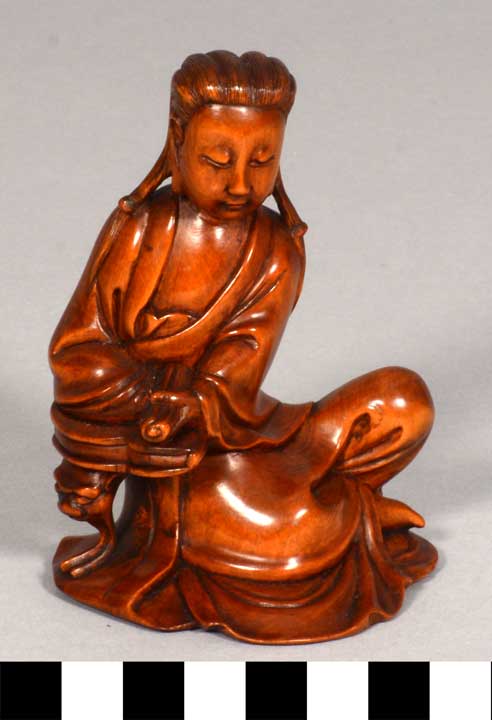
Figurine: Guanyin (Kannon, Kuanyin, Avalokiteshvara)2004.13.0019 (2004.13.0019)
11.2 x 8 x 7 cm (104 g)
Location: Asia, East: China
Period: Qing Dynasty (1644-1911); 18th or 19th Century
Classification/Nomenclature: Communication Artifacts : Art
Description: This is a Chinese boxwood carving of Guanyin (Kuan Yin), the Chinese name for the Bodhisattva Avalokitesvara...
Period: Qing Dynasty (1644-1911); 18th or 19th Century
Classification/Nomenclature: Communication Artifacts : Art
Description: This is a Chinese boxwood carving of Guanyin (Kuan Yin), the Chinese name for the Bodhisattva Avalokitesvara...
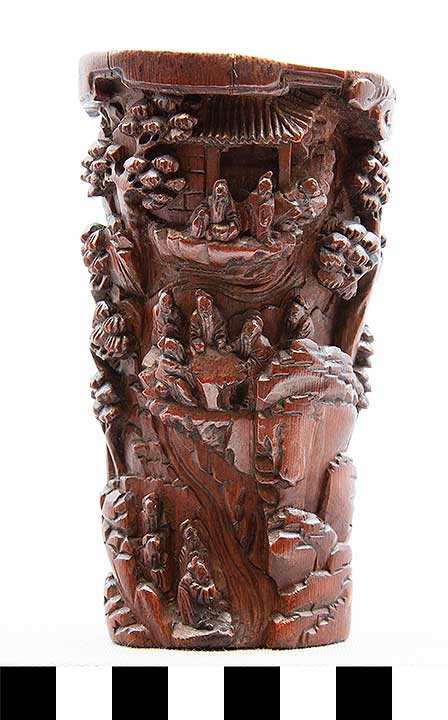
Bitong, Brush Pot2004.13.0020 (2004.13.0020)
11.3 x 6.2 x 4.7 cm ( g)
Location: Asia, East: China
Period: Qing Dynasty (1644-1911); 18th Century
Classification/Nomenclature: Communication T&E : Written Communication T&E : Writing Accessories
Description: The Chinese bitong (brush pot) was an ideal interior design piece for the scholar's desk. The concept of the "four treasures" (inkstone, ink, brush, and paper) of a scholar's study became an appreciated facet of interior design during the Song Dynasty (960-1279)...
Period: Qing Dynasty (1644-1911); 18th Century
Classification/Nomenclature: Communication T&E : Written Communication T&E : Writing Accessories
Description: The Chinese bitong (brush pot) was an ideal interior design piece for the scholar's desk. The concept of the "four treasures" (inkstone, ink, brush, and paper) of a scholar's study became an appreciated facet of interior design during the Song Dynasty (960-1279)...
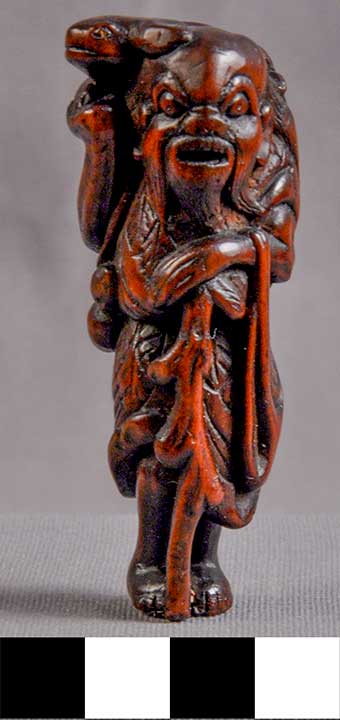
Netsuke: Gama Sennin, Daoist Holy Man, with Three-legged Toad2004.13.0021 (2004.13.0021)
7 x 2.8 x 2.7 cm (18 g)
Location: Asia, East: Japan
Period: Late Edo Period or Early Meiji Period; 19th century
Classification/Nomenclature: Personal Artifacts : Personal Gear : Personal Carrying & Storage Gear
Description: This is a netsuke of Gama Sennin with a three-legged toad. Sennin are Daoist holy men who have reached immortality...
Period: Late Edo Period or Early Meiji Period; 19th century
Classification/Nomenclature: Personal Artifacts : Personal Gear : Personal Carrying & Storage Gear
Description: This is a netsuke of Gama Sennin with a three-legged toad. Sennin are Daoist holy men who have reached immortality...
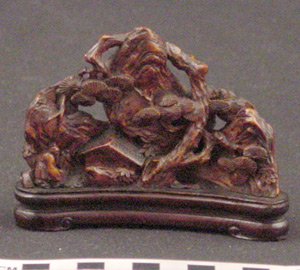
Brush Rest2004.13.0022 (2004.13.0022)
11 x 8 x 3 cm (60 g)
Location: Asia, East: China
Period: Ming Dynasty (1368-1644) - Qing Dynasty (1644-1911); 17th century
Classification/Nomenclature: Communication T&E : Written Communication T&E : Writing Accessories
Description: Brush rests were among the coveted items made for the Chinese scholar's desk. This type of brush rest, typically constructed of ivory, is made of bamboo...
Period: Ming Dynasty (1368-1644) - Qing Dynasty (1644-1911); 17th century
Classification/Nomenclature: Communication T&E : Written Communication T&E : Writing Accessories
Description: Brush rests were among the coveted items made for the Chinese scholar's desk. This type of brush rest, typically constructed of ivory, is made of bamboo...
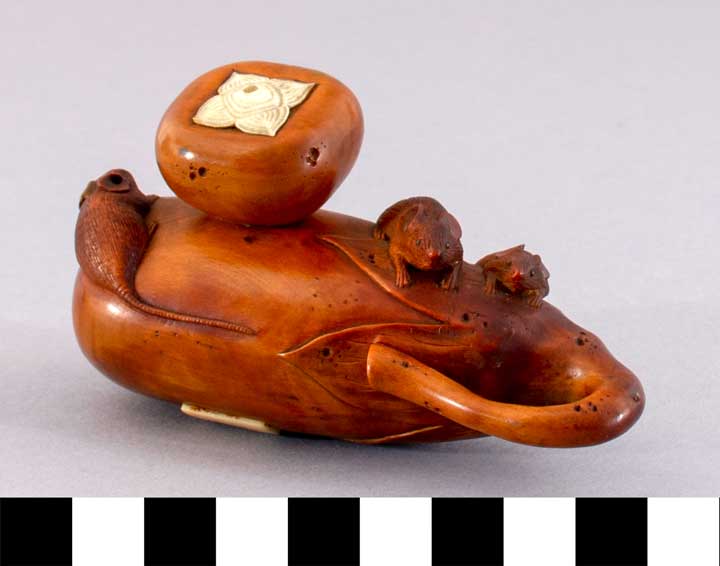
Okimono: Eggplant with three rats2004.13.0023 (2004.13.0023)
10.8 x 4.5 x 4 cm (102 g)
Location: Asia, East: Japan
Period: Meiji Period (1868-1912); Late 19th century
Classification/Nomenclature: Communication Artifacts : Art
Description: This is a Japanese okimono of a group of rats on an eggplant signed by Sanju Saku. The rat is one of the twelve animals of the duodenary cycle and is often featured in Japanese art...
Period: Meiji Period (1868-1912); Late 19th century
Classification/Nomenclature: Communication Artifacts : Art
Description: This is a Japanese okimono of a group of rats on an eggplant signed by Sanju Saku. The rat is one of the twelve animals of the duodenary cycle and is often featured in Japanese art...
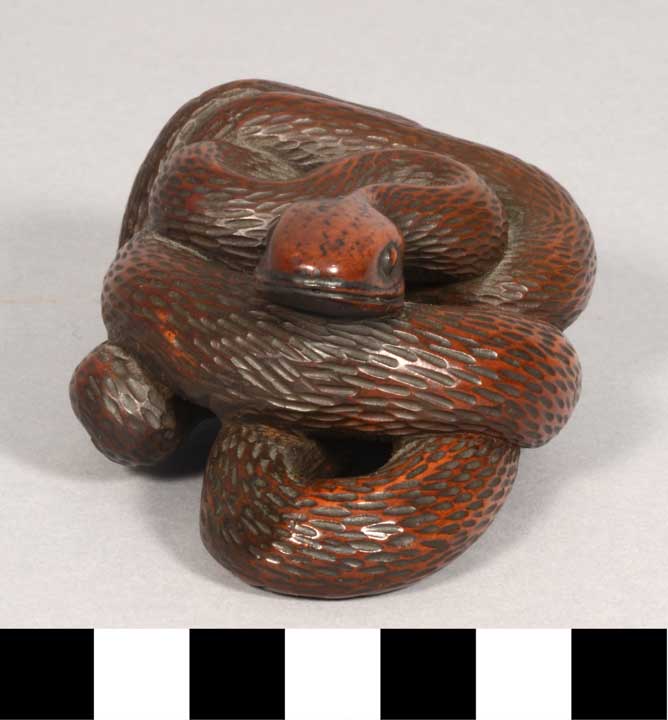
Okimono: Coiled Snake2004.13.0024 (2004.13.0024)
8 x 6 x 4 cm (71 g)
Location: Asia, East: Japan
Period: Meiji Period (1868-1912); Late 19th century
Classification/Nomenclature: Communication Artifacts : Art
Description: This is a Japanese okimono of a coiled snake. The snake is one of the twelve animals of the duodenary cycle and is often featured in Japanese art...
Period: Meiji Period (1868-1912); Late 19th century
Classification/Nomenclature: Communication Artifacts : Art
Description: This is a Japanese okimono of a coiled snake. The snake is one of the twelve animals of the duodenary cycle and is often featured in Japanese art...
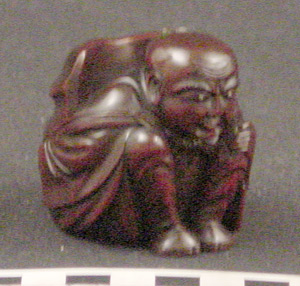
Netsuke: Man Carrying a Tengu Mask2004.13.0025 (2004.13.0025)
5.4 x 5.2 x 4.3 cm (65 g)
Location: Asia, East: Japan
Period: Late Edo Period (1603-1868) - Early Meiji Period (1868-1912); 19th century
Classification/Nomenclature: Personal Artifacts : Personal Gear : Personal Carrying & Storage Gear
Description: This is a netsuke of a man carrying a tengu mask. The tengu is a forest and mountain goblin with both Shinto and Buddhist attributes...
Period: Late Edo Period (1603-1868) - Early Meiji Period (1868-1912); 19th century
Classification/Nomenclature: Personal Artifacts : Personal Gear : Personal Carrying & Storage Gear
Description: This is a netsuke of a man carrying a tengu mask. The tengu is a forest and mountain goblin with both Shinto and Buddhist attributes...
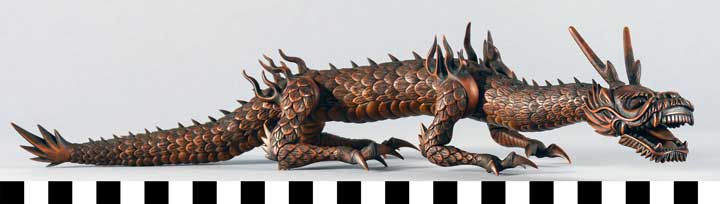
Okimono: Dragon2004.13.0026 (2004.13.0026)
33 x 7.2 x 5.5 cm (96 g)
Location: Asia, East: Japan
Period: Late Edo Period (1603-1868) - Early Meiji Period (1868-1912); 19th century
Classification/Nomenclature: Communication Artifacts : Art
Description: This is a Japanese okimono of a dragon, one of the twelve animals of the duodenary cycle that is often featured in Japanese art...
Period: Late Edo Period (1603-1868) - Early Meiji Period (1868-1912); 19th century
Classification/Nomenclature: Communication Artifacts : Art
Description: This is a Japanese okimono of a dragon, one of the twelve animals of the duodenary cycle that is often featured in Japanese art...
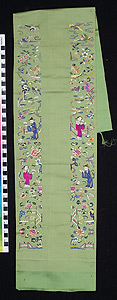
Cuff2004.14.0001 (2004.14.0001)
91.2 x 29.6 x .1 cm (34 g)
Location: Asia, East: China
Period: Qing Dynasty (1644-1911); 1800 -1911 CE
Classification/Nomenclature: Personal Artifacts : Clothing : Clothing Accessories
Period: Qing Dynasty (1644-1911); 1800 -1911 CE
Classification/Nomenclature: Personal Artifacts : Clothing : Clothing Accessories
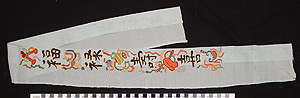
Cuff2004.14.0002A (2004.14.0002A)
111.2 x 13 x .1 cm (14 g)
Location: Asia, East: China
Period: Qing Dynasty (1644-1911); 1800-1911 CE
Classification/Nomenclature: Personal Artifacts : Clothing : Clothing Accessories
Period: Qing Dynasty (1644-1911); 1800-1911 CE
Classification/Nomenclature: Personal Artifacts : Clothing : Clothing Accessories
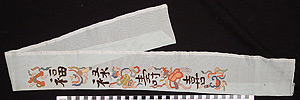
Cuff2004.14.0002B (2004.14.0002B)
110.8 x 13.8 x .1 cm (15 g)
Location: Asia, East: China
Period: Qing Dynasty (1644-1911); 1800-1911 CE
Classification/Nomenclature: Personal Artifacts : Clothing : Clothing Accessories
Period: Qing Dynasty (1644-1911); 1800-1911 CE
Classification/Nomenclature: Personal Artifacts : Clothing : Clothing Accessories
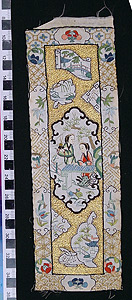
Cuff2004.14.0003A (2004.14.0003A)
27.2 x 9 x .1 cm (4 g)
Location: Asia, East: China
Period: Qing Dynasty (1644-1911); 1800-1911 CE
Classification/Nomenclature: Personal Artifacts : Clothing : Clothing Accessories
Period: Qing Dynasty (1644-1911); 1800-1911 CE
Classification/Nomenclature: Personal Artifacts : Clothing : Clothing Accessories
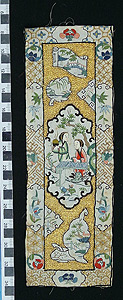
Cuff2004.14.0003B (2004.14.0003B)
26.9 x 9 x .1 cm (3 g)
Location: Asia, East: China
Period: Qing Dynasty (1644-1911); 1800-1911 CE
Classification/Nomenclature: Personal Artifacts : Clothing : Clothing Accessories
Period: Qing Dynasty (1644-1911); 1800-1911 CE
Classification/Nomenclature: Personal Artifacts : Clothing : Clothing Accessories
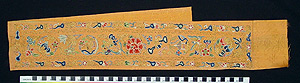
Cuff2004.14.0004A (2004.14.0004A)
98.3 x 17.6 x .1 cm (18 g)
Location: Asia, East: China
Period: Qing Dynasty (1644-1911); 1800-1911 CE
Classification/Nomenclature: Personal Artifacts : Clothing : Clothing Accessories
Period: Qing Dynasty (1644-1911); 1800-1911 CE
Classification/Nomenclature: Personal Artifacts : Clothing : Clothing Accessories
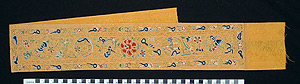
Cuff2004.14.0004B (2004.14.0004B)
97.6 x 18.8 x .1 cm (18 g)
Location: Asia, East: China
Period: Qing Dynasty (1644-1911); 1800-1911 CE
Classification/Nomenclature: Personal Artifacts : Clothing : Clothing Accessories
Period: Qing Dynasty (1644-1911); 1800-1911 CE
Classification/Nomenclature: Personal Artifacts : Clothing : Clothing Accessories
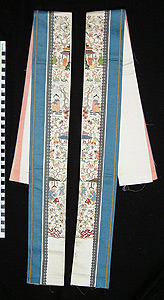
Cuff2004.14.0005A (2004.14.0005A)
112 x 9 cm (65 g)
Location: Asia, East: China
Period: Qing Dynasty (1644-1911); 1800-1911 CE
Classification/Nomenclature: Personal Artifacts : Clothing : Clothing Accessories
Period: Qing Dynasty (1644-1911); 1800-1911 CE
Classification/Nomenclature: Personal Artifacts : Clothing : Clothing Accessories
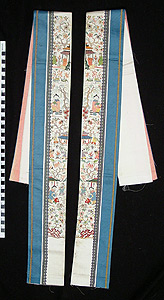
Cuff2004.14.0005B (2004.14.0005B)
112 x 9 cm (65 g)
Location: Asia, East: China
Period: Qing Dynasty (1644-1911); 1800-1911 CE
Classification/Nomenclature: Personal Artifacts : Clothing : Clothing Accessories
Period: Qing Dynasty (1644-1911); 1800-1911 CE
Classification/Nomenclature: Personal Artifacts : Clothing : Clothing Accessories
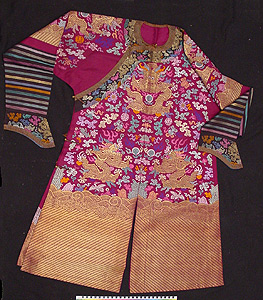
Robe2004.14.0006 (2004.14.0006)
130 x 99.5 cm (864 g)
Location: Asia, East: China
Period: Qing Dynasty (1644-1911); Probably Late Qing Dynasty (1644-1911)
Classification/Nomenclature: Personal Artifacts : Clothing : Main Garments
Period: Qing Dynasty (1644-1911); Probably Late Qing Dynasty (1644-1911)
Classification/Nomenclature: Personal Artifacts : Clothing : Main Garments
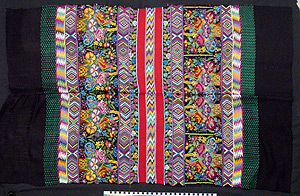
Textile2004.15.0001 (2004.15.0001)
125.8 x 77 x .2 cm (600 g)
Location: America, Central: Guatemala: Chimaltenango Department: San Juan Comalapa
Period: Contemporary; 1983 - 1995
Classification/Nomenclature: Unclassifiable Artifacts
Period: Contemporary; 1983 - 1995
Classification/Nomenclature: Unclassifiable Artifacts
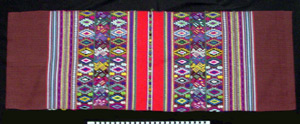
Half of a Huipil, Po't, Blouse2004.15.0002A (2004.15.0002A)
118 x 41.4 x .2 cm (189 g)
Location: America, Central: Guatemala: Chimaltenango Department: San Juan Comalapa
Period: Contemporary; 1983 - 1995
Classification/Nomenclature: Unclassifiable Artifacts
Period: Contemporary; 1983 - 1995
Classification/Nomenclature: Unclassifiable Artifacts
Search Examples
Explore More
Access the public portions of the catalog records for the approximately 50,000 cultural and ethnographic objects in the Museum's Artifact Collection.