
Search Results
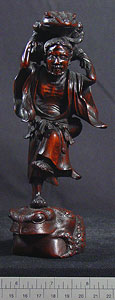
Okimono: Gama Sennin, Daoist Holy Man2006.12.0009 (2006.12.0009)
18.5 x 8 x 7.5 cm (124 g)
Location: Asia, East: Japan
Period: Meiji Period (1868-1912); Late 19th Century
Classification/Nomenclature: Communication Artifacts : Art
Description: This is a Japanese okimono of the Gama Sennin with two frogs. The Sennin (also termed Rishi) are Daoist holy men who reached immortality...
Period: Meiji Period (1868-1912); Late 19th Century
Classification/Nomenclature: Communication Artifacts : Art
Description: This is a Japanese okimono of the Gama Sennin with two frogs. The Sennin (also termed Rishi) are Daoist holy men who reached immortality...
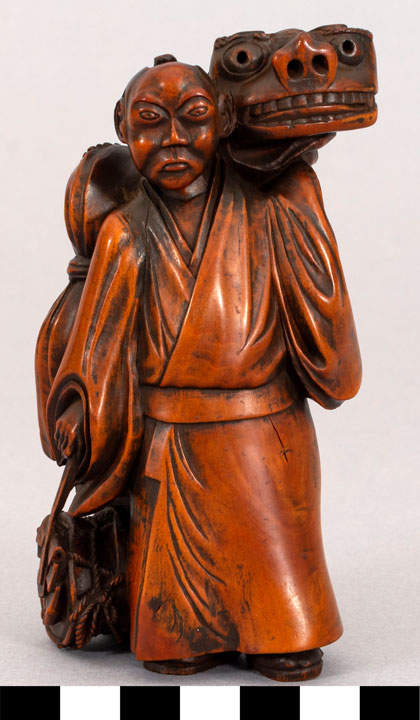
Okimono: Entertainer/Dancer, Japanese Lion Dance2006.12.0010 (2006.12.0010)
11.5 x 6 x 4.1 cm (111 g)
Location: Asia, East: Japan
Period: Edo Period (1603-1868); Late 18th Century
Classification/Nomenclature: Communication Artifacts : Art
Description: This is a Japanese boxwood okimono of an entertainer with a drum and a shishi-mai (lion dance) costume...
Period: Edo Period (1603-1868); Late 18th Century
Classification/Nomenclature: Communication Artifacts : Art
Description: This is a Japanese boxwood okimono of an entertainer with a drum and a shishi-mai (lion dance) costume...
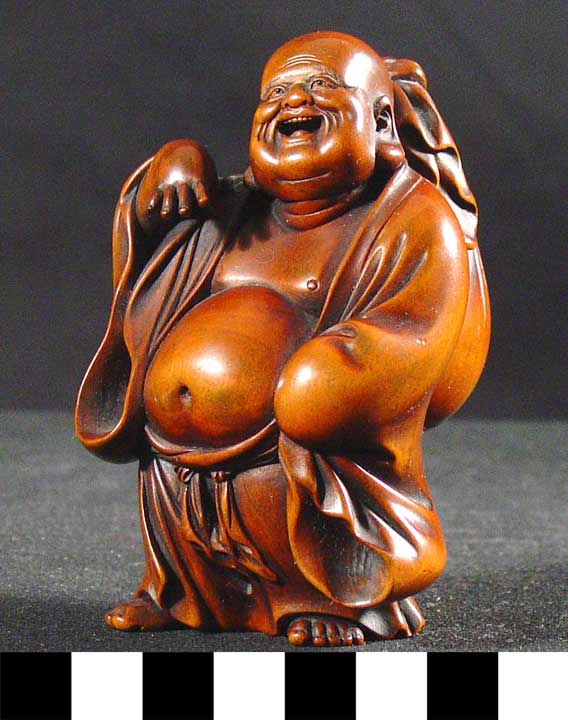
Okimono: Hotei (Budai, Pudai), God of Happiness and Laughter2006.12.0011A (2006.12.0011A)
9.5 x 6.5 x 3.5 cm (104 g)
Location: Asia, East: Japan
Period: Meiji Period (1868-1912); 1868-1912
Classification/Nomenclature: Communication Artifacts : Art
Description: This is a Japanese okimono of Hotei, one of the Shichi Fukujin (Seven Gods of Good Luck). He is often depicted as a deity with a protruding stomach that carries a large sack and a staff...
Period: Meiji Period (1868-1912); 1868-1912
Classification/Nomenclature: Communication Artifacts : Art
Description: This is a Japanese okimono of Hotei, one of the Shichi Fukujin (Seven Gods of Good Luck). He is often depicted as a deity with a protruding stomach that carries a large sack and a staff...
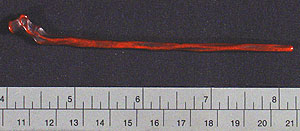
Okimono: Hotei (Budai, Pudai), God of Happiness and Laughter, Cane2006.12.0011B (2006.12.0011B)
10.8 x .4 x .6 cm (<1 g)
Location: Asia, East: Japan
Period: Meiji Period (1868-1912); 1868-1912
Classification/Nomenclature: Communication Artifacts : Art
Description: This is a the cane for a Japanese okimono of Hotei, one of the Shichi Fukujin (Seven Gods of Good Luck)...
Period: Meiji Period (1868-1912); 1868-1912
Classification/Nomenclature: Communication Artifacts : Art
Description: This is a the cane for a Japanese okimono of Hotei, one of the Shichi Fukujin (Seven Gods of Good Luck)...
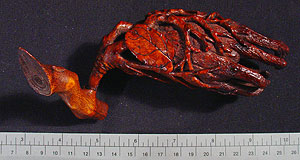
Carving: Finger Citron (“Buddha’s Hand”)2006.12.0012 (2006.12.0012)
14 x 7.2 x 4.3 cm (74 g)
Location: Asia, East: China
Period: Qing Dynasty (1644-1911); 18th Century
Classification/Nomenclature: Communication Artifacts : Art
Description: This is a carving of a Chinese finger citron, also known as Buddha's Hand (Fo Shou), with its branch carved and pitted to suggest that it was torn away from the tree...
Period: Qing Dynasty (1644-1911); 18th Century
Classification/Nomenclature: Communication Artifacts : Art
Description: This is a carving of a Chinese finger citron, also known as Buddha's Hand (Fo Shou), with its branch carved and pitted to suggest that it was torn away from the tree...
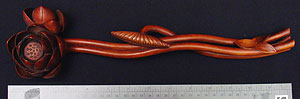
Lotus Ruyi, Scepter2006.12.0013A (2006.12.0013A)
33.8 x 8.7 x 5.2 cm (143 g)
Location: Asia, East: Japan
Period: Late Edo Period; 1740 - 1868
Classification/Nomenclature: Communication Artifacts : Personal Symbols : Status Symbols
Description: "A Japanese boxwood ruyi (scepter) with a network of seeds within the open lotus at the terminal of a long stalk, a second stalk with a closed lotus, and a third furled lotus emanating from a 3rd lower stalk, the stalks gently and gracefully curved, the lower section of the stalks with another leaf...
Period: Late Edo Period; 1740 - 1868
Classification/Nomenclature: Communication Artifacts : Personal Symbols : Status Symbols
Description: "A Japanese boxwood ruyi (scepter) with a network of seeds within the open lotus at the terminal of a long stalk, a second stalk with a closed lotus, and a third furled lotus emanating from a 3rd lower stalk, the stalks gently and gracefully curved, the lower section of the stalks with another leaf...
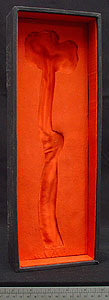
Box for Ruyi (Scepter), Lotus Shape2006.12.0013B (2006.12.0013B)
38.4 x 13.2 x 6.5 cm (378 g)
Location: Asia, East: Japan
Classification/Nomenclature: Furnishings : Furniture : Storage & Display Furniture
Classification/Nomenclature: Furnishings : Furniture : Storage & Display Furniture
Box Insert for Ruyi (Scepter), Lotus Shape2006.12.0013C (2006.12.0013C)
37.3 x 11.8 x .8 cm (67 g)
Location: Asia, East: Japan
Classification/Nomenclature: Furnishings : Furniture : Storage & Display Furniture
Classification/Nomenclature: Furnishings : Furniture : Storage & Display Furniture
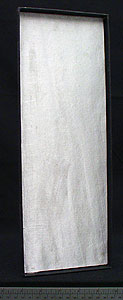
Box Lid for Ruyi, Scepter, Lotus Shape2006.12.0013D (2006.12.0013D)
38.9 x 13.8 x 1.5 cm (164 g)
Location: Asia, East: Japan
Classification/Nomenclature: Furnishings : Furniture : Storage & Display Furniture
Classification/Nomenclature: Furnishings : Furniture : Storage & Display Furniture
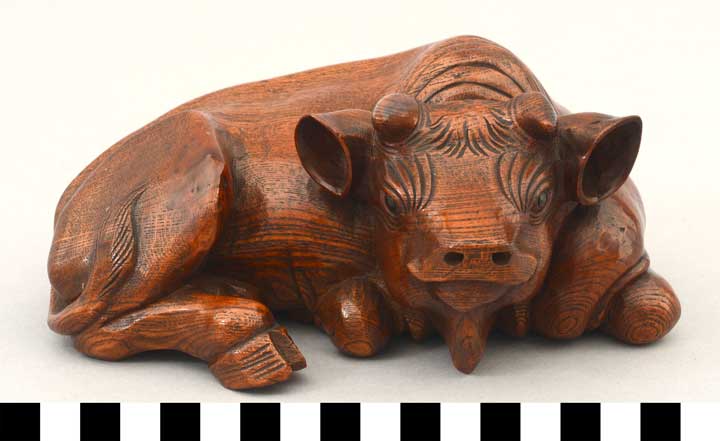
Okimono: Recumbent Ox2006.12.0014A (2006.12.0014A)
17.8 x 12.9 x 7.5 cm (398 g)
Location: Asia, East: Japan
Period: Meiji Period (1868-1912); 1901
Classification/Nomenclature: Communication Artifacts : Art
Description: This is a Japanese okimono of a recumbent ox signed by Ei Yuki To. It is carved from Keyaki (Zelkova) wood which is generally used for expensive tansu (Japanese chests)...
Period: Meiji Period (1868-1912); 1901
Classification/Nomenclature: Communication Artifacts : Art
Description: This is a Japanese okimono of a recumbent ox signed by Ei Yuki To. It is carved from Keyaki (Zelkova) wood which is generally used for expensive tansu (Japanese chests)...
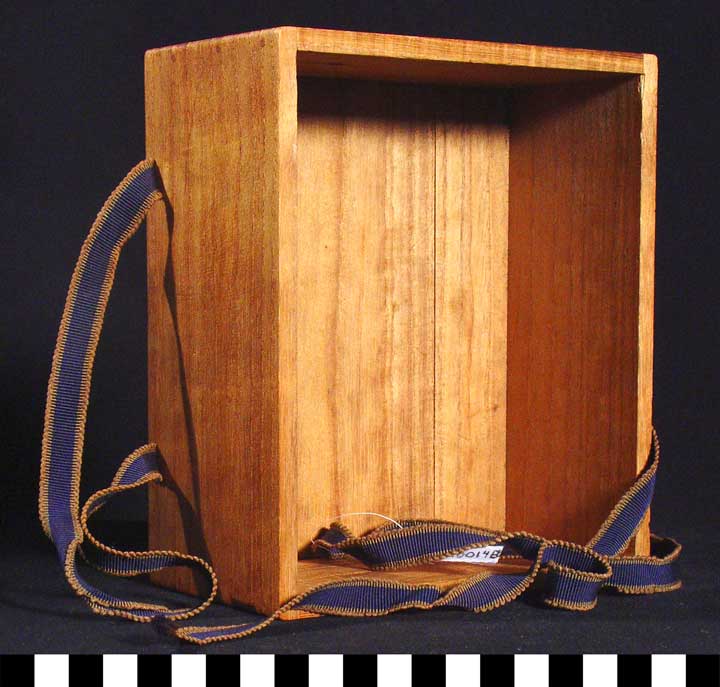
Box for Okimono of a Recumbent Ox2006.12.0014B (2006.12.0014B)
18.5 x 15.7 x 8.6 cm (174 g)
Location: Asia, East: Japan
Period: Meiji Period (1868-1912), Taisho Period (1912-1926), Showa Period (1926-1989); 1901-late 20th century
Classification/Nomenclature: Furnishings : Furniture : Storage & Display Furniture
Description: This is the box for a Japanese okimono of a recumbent ox. It is carved from Keyaki (Zelkova) wood which is generally used for expensive tansu (Japanese chests)...
Period: Meiji Period (1868-1912), Taisho Period (1912-1926), Showa Period (1926-1989); 1901-late 20th century
Classification/Nomenclature: Furnishings : Furniture : Storage & Display Furniture
Description: This is the box for a Japanese okimono of a recumbent ox. It is carved from Keyaki (Zelkova) wood which is generally used for expensive tansu (Japanese chests)...
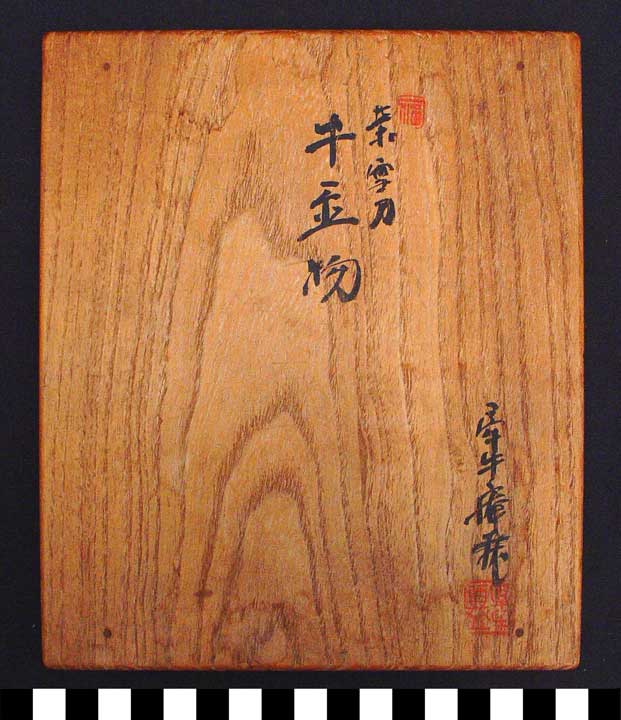
Box Lid for Okimono of a Recumbent Ox2006.12.0014C (2006.12.0014C)
18.5 x 15.6 x 2 cm (67 g)
Location: Asia, East: Japan
Period: Meiji Period (1868-1912), Taisho Period (1912-1926), Showa Period (1926-1989); 1901-late 20th century
Classification/Nomenclature: Furnishings : Furniture : Storage & Display Furniture
Description: This is the box lid for a Japanese okimono of a recumbent ox. It is carved from Keyaki (Zelkova) wood which is generally used for expensive tansu (Japanese chests)...
Period: Meiji Period (1868-1912), Taisho Period (1912-1926), Showa Period (1926-1989); 1901-late 20th century
Classification/Nomenclature: Furnishings : Furniture : Storage & Display Furniture
Description: This is the box lid for a Japanese okimono of a recumbent ox. It is carved from Keyaki (Zelkova) wood which is generally used for expensive tansu (Japanese chests)...
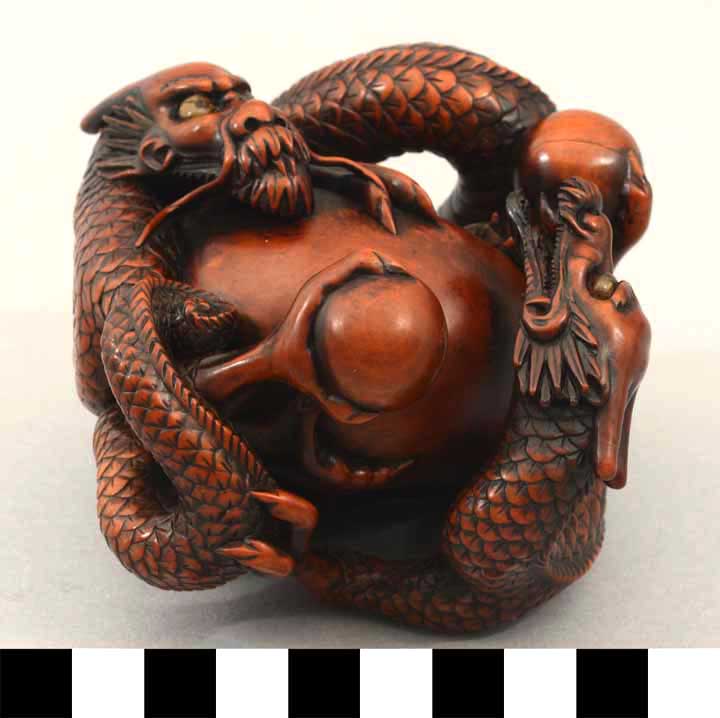
Okimono: Two Entwined Dragons2006.12.0015 (2006.12.0015)
9.5 x 8.6 x 7.1 cm (168 g)
Location: Asia, East: Japan
Period: Late Edo Period (1603-1868) - Early Meiji Period (1868-1912); 19th Century
Classification/Nomenclature: Communication Artifacts : Art
Description: This is a Japanese okimono of two entwined dragons, both holding a pearl of truth. The dragon is regarded as the most important animal of the duodenary cycle with the year of the dragon being regarded as auspicious...
Period: Late Edo Period (1603-1868) - Early Meiji Period (1868-1912); 19th Century
Classification/Nomenclature: Communication Artifacts : Art
Description: This is a Japanese okimono of two entwined dragons, both holding a pearl of truth. The dragon is regarded as the most important animal of the duodenary cycle with the year of the dragon being regarded as auspicious...
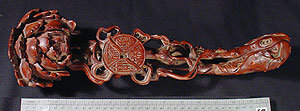
Peony Blossom Ruyi, Scepter2006.12.0016 (2006.12.0016)
41 x 11.5 x 8.2 cm (525 g)
Location: Asia, East: China
Period: Qing Dynasty (1644-1911); 18th Century
Classification/Nomenclature: Communication Artifacts : Personal Symbols : Status Symbols
Description: This is a Chinese wood carving of a ruyi (Jui), a curved and scepter-like emblem of rank which was used in court ceremonies and appears in Buddhist iconography as a symbol of religious dialogue...
Period: Qing Dynasty (1644-1911); 18th Century
Classification/Nomenclature: Communication Artifacts : Personal Symbols : Status Symbols
Description: This is a Chinese wood carving of a ruyi (Jui), a curved and scepter-like emblem of rank which was used in court ceremonies and appears in Buddhist iconography as a symbol of religious dialogue...
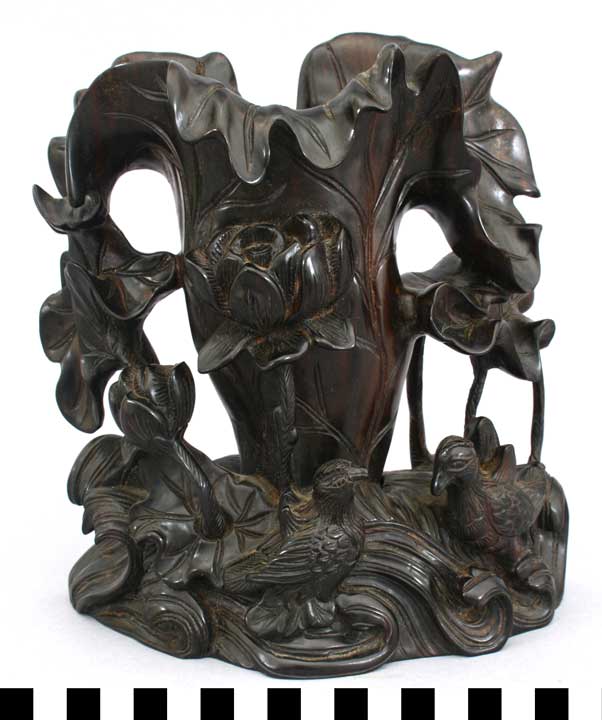
Joss, Incense, Stick Holder2006.12.0017 (2006.12.0017)
19.5 x 18.3 x 8.7 cm (1078 g)
Location: Asia, East: China
Period: Qing Dynasty (1644-1911); 19th Century
Classification/Nomenclature: Furnishings : Household Accessories : Other Household Accessories
Description: An incense holder of the Qing Dynasty (1644-1911) is a valuable interior design item meant for the Chinese scholar's desk...
Period: Qing Dynasty (1644-1911); 19th Century
Classification/Nomenclature: Furnishings : Household Accessories : Other Household Accessories
Description: An incense holder of the Qing Dynasty (1644-1911) is a valuable interior design item meant for the Chinese scholar's desk...
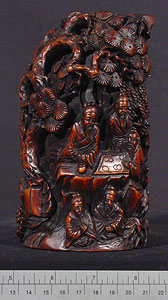
Carving: Mountain2006.12.0018A (2006.12.0018A)
10 x 9.5 x 15.2 cm (627 g)
Location: Asia, East: China
Period: Qing Dynasty (1644-1911); 18th - early 19th century
Classification/Nomenclature: Communication Artifacts : Art
Description: This item is a Chinese rootwood sculpture of a mountain with religious figures and possesses a design representative of Buddhism, Daoism, and Confucianism...
Period: Qing Dynasty (1644-1911); 18th - early 19th century
Classification/Nomenclature: Communication Artifacts : Art
Description: This item is a Chinese rootwood sculpture of a mountain with religious figures and possesses a design representative of Buddhism, Daoism, and Confucianism...
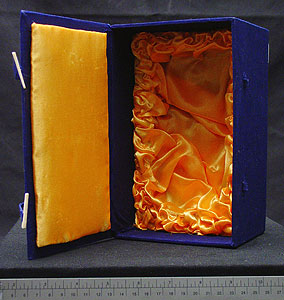
Carving: Mountain, Box2006.12.0018B (2006.12.0018B)
21 x 12.5 x 11.5 cm (391 g)
Location: Asia, East: China
Period: Qing Dynasty (1644-1911); 18th - Early 19th centuries
Classification/Nomenclature: Furnishings : Furniture : Storage & Display Furniture
Description: This is a box for the Chinese rootwood carving of a scenic mountain with religious iconography. The box is covered with blue cloth and possesses gold satin material in its interior...
Period: Qing Dynasty (1644-1911); 18th - Early 19th centuries
Classification/Nomenclature: Furnishings : Furniture : Storage & Display Furniture
Description: This is a box for the Chinese rootwood carving of a scenic mountain with religious iconography. The box is covered with blue cloth and possesses gold satin material in its interior...
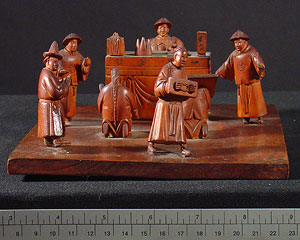
Model: Chinese Criminal Court Room2006.12.0019 (2006.12.0019)
18 x 15.8 x 7 cm (232 g)
Location: Asia, East: China: Possibly Canton
Period: Qing Dynasty (1644-1911); Early to mid - 19th Century
Classification/Nomenclature: Communication Artifacts : Documentary Artifacts : Other Documents
Description: This is a carved lacquer model of a Chinese court room with a design meant to convey a scene of deliberation and decision-making...
Period: Qing Dynasty (1644-1911); Early to mid - 19th Century
Classification/Nomenclature: Communication Artifacts : Documentary Artifacts : Other Documents
Description: This is a carved lacquer model of a Chinese court room with a design meant to convey a scene of deliberation and decision-making...
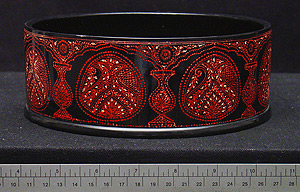
Box2006.13.0001A (2006.13.0001A)
19.8 x 6.6 cm (322 g)
Location: Asia, South: Pakistan
Period: 1992 - 1993
Classification/Nomenclature: Furnishings : Household Accessories : Storage & Display Accessories
Period: 1992 - 1993
Classification/Nomenclature: Furnishings : Household Accessories : Storage & Display Accessories
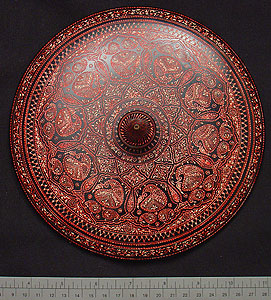
Box Lid2006.13.0001B (2006.13.0001B)
19.3 x 7 cm (200 g)
Location: Asia, South: Pakistan
Period: 1992 - 1993
Classification/Nomenclature: Furnishings : Household Accessories : Storage & Display Accessories
Period: 1992 - 1993
Classification/Nomenclature: Furnishings : Household Accessories : Storage & Display Accessories
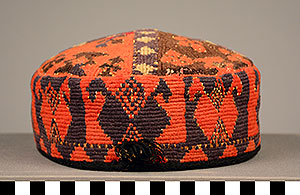
Boy’s Hat2006.13.0002 (2006.13.0002)
16 x 5.5 x .1 cm (87 g)
Location: Asia, South: Afghanistan, Pakistan: Swat Valley
Period: 1992 - 1993
Classification/Nomenclature: Personal Artifacts : Clothing : Headwear
Period: 1992 - 1993
Classification/Nomenclature: Personal Artifacts : Clothing : Headwear
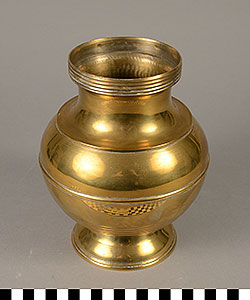
Milk Container2006.13.0003A (2006.13.0003A)
19.5 x 16 cm (781 g)
Location: Asia, South: Pakistan
Period: 1992 - 1993
Classification/Nomenclature: Materials T&E : Food Processing & Preparation T&E : Food Storage Equipment
Period: 1992 - 1993
Classification/Nomenclature: Materials T&E : Food Processing & Preparation T&E : Food Storage Equipment
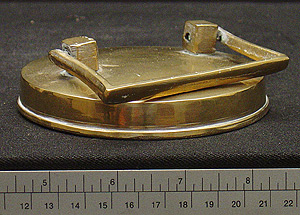
Milk Container Lid2006.13.0003B (2006.13.0003B)
10.5 x 3 cm (234 g)
Location: Asia, South: Pakistan
Period: 1992 - 1993
Classification/Nomenclature: Materials T&E : Food Processing & Preparation T&E : Food Storage Equipment
Period: 1992 - 1993
Classification/Nomenclature: Materials T&E : Food Processing & Preparation T&E : Food Storage Equipment
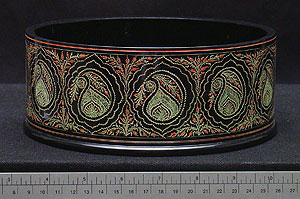
Box2006.13.0004A (2006.13.0004A)
19.5 x 7.5 cm (379 g)
Location: Asia, South: Pakistan
Period: 1992 - 1993
Classification/Nomenclature: Furnishings : Household Accessories : Storage & Display Accessories
Period: 1992 - 1993
Classification/Nomenclature: Furnishings : Household Accessories : Storage & Display Accessories
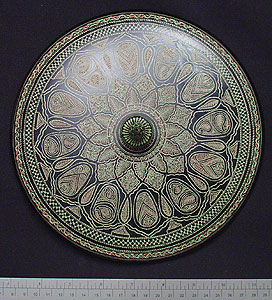
Box Lid2006.13.0004B (2006.13.0004B)
21 x 6 cm (301 g)
Location: Asia, South: Pakistan
Period: 1992 - 1993
Classification/Nomenclature: Furnishings : Household Accessories : Storage & Display Accessories
Period: 1992 - 1993
Classification/Nomenclature: Furnishings : Household Accessories : Storage & Display Accessories
Search Examples
Explore More
Access the public portions of the catalog records for the approximately 50,000 cultural and ethnographic objects in the Museum's Artifact Collection.