
Navigating Fengshui: The Compass as a Tool of Divination
- Post Date: 4/3/2026
- Author: Harrison Taylor, registration student assistant
- Reading Time: 11 minute read
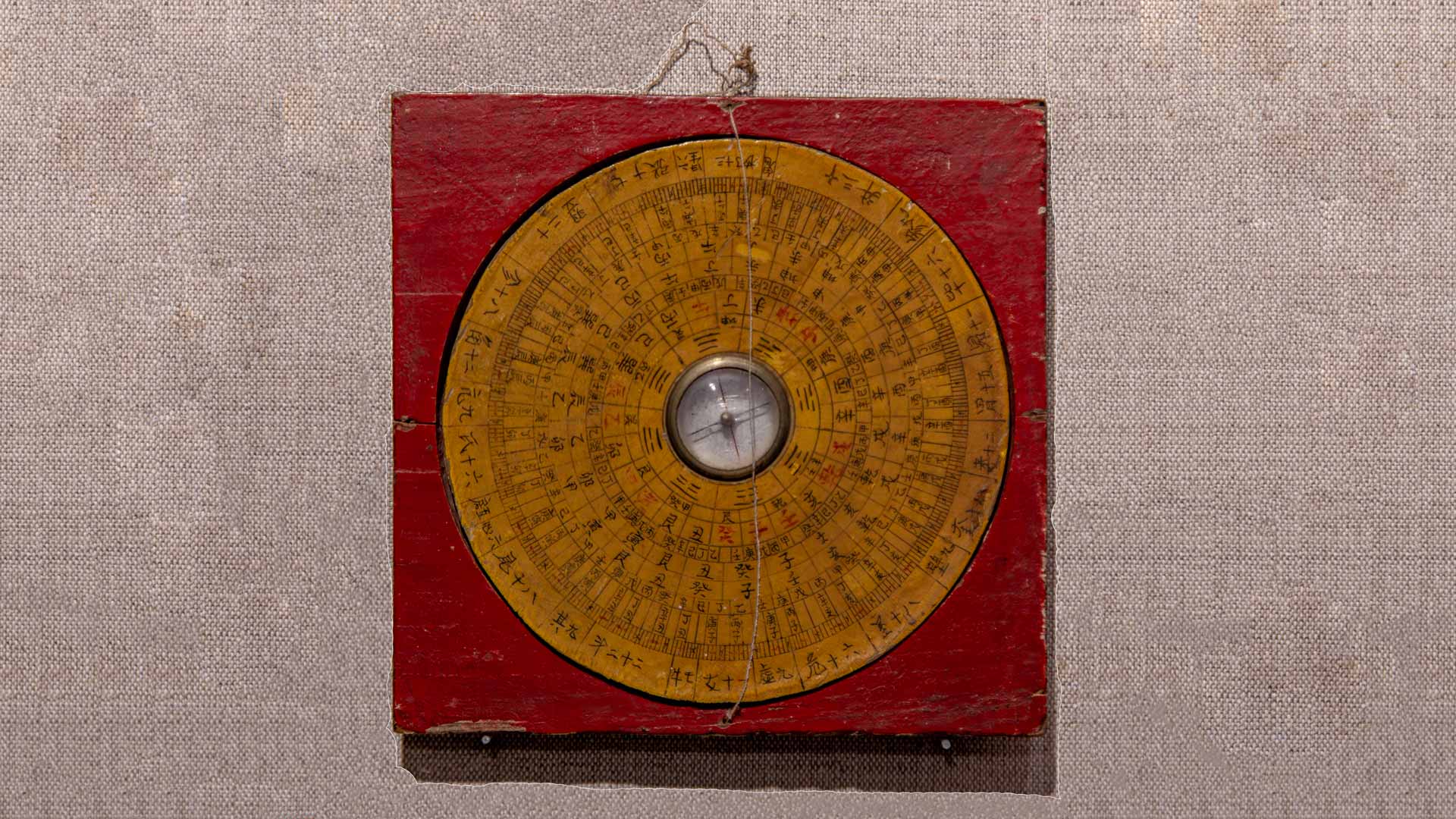
A visit to the Spurlock Museum is an exciting experience for me, because every time I go something new seems to jumps out and capture my attention. I recently had this experience when I saw a Qing-era compass amidst a plethora of navigational mathematical devices. You can see this artifact in the Spurlock exhibit “East Asia: Invention, Exchange, Endurance.” The luopan (罗盘) is the oldest magnetic compass in the world. First invented in the Han Dynasty (206BCE–220CE), the compass was not used as a navigational tool until the Song Dynasty, nearly 800 years later. The original luopan had a very different purpose, as a divining tool used in the traditional art of fengshui.
What is Fengshui?
The term fengshui (风水) is derived from the characters 风feng meaning air or wind, and 水 (shui), meaning water. The goal of this practice is to understand the movement of qi and the optimal placement of people, structures, and settlements in relation to their environment (Chen, 2004). Qi refers to the energy that persists and flows throughout all things. It is an essential aspect of many East Asian cosmologies.
There are dozens of schools of fengshui, each with their own approach to the discipline. In both rural and urban contexts, fengshui continues to be practiced for a myriad of reasons, including urban planning, traditional medicine, burial orientation, and interior design. The practice has spread far beyond East Asia and modern practitioners can be found working across the globe. Fengshui is a multifaceted tradition, each function having its own unique history and theory. The luopan is a tool within fengshui that is most often used to understand orientation and auspicious sequences.
Chen Bi Xia summarizes the purpose of fengshui simply. It is to “place oneself spatially and temporally in an appropriate relation to the flow of natural processes (Feuchtwang, 1974)…to understand the movement of energy (qi) through a landscape, and how that movement is affected by the altitude and placement of mountains, trees, and rivers, as well as man-made features, through time (Leonard 2000)” (Chen 2004, 298).
The History of Fengshui
Although the term fengshui would not appear until the 4th century CE, the philosophy’s roots can be traced back to a neolithic origin. Ancient Chinese cosmology holds Four Celestial Deities reflected as constellations in the night sky, which represent the cardinal directions: The phoenix (朱鸟) in the south, the tiger (白虎) in the west, the turtle (玄武) in the north, and the dragon (青龙) in the east (Shen, 2011). 200 years later in the Han Dynasty (206BCE–220CE), a device known as a cosmograph began appearing in elite tombs (Field, 2011). These consist of a square base with a round disc on top, representing the Earth and the heavens respectively. The square plate is divided into twelve Earthly Branches, and the circular disc has 28 zodiac constellations. This design shares significant parallels with the luopan, and the concepts of the Four Celestial Deities and the cosmograph would later be the basis of the first two schools of fengshui—the Form School, and the Compass School.
The Form School, also called Kanyu (堪舆), is the oldest fengshui system. It is first described by philosopher Guo Pu (郭璞) in the Book of Burial (葬书), written in the 4th century CE. This book is also the first to introduce the term fengshui.
Qi rides the feng (wind) and scatters, but is retained when encountering shui (water). The ancients collected it to prevent its dissipation and guided it to assure its retention. Thus it was called fengshui. According to the laws of fengshui, the site which attracts water is optimum, followed by the site which catches wind.Guo Pu in the Book of Burial
The Compass School emerged during the Song Dynasty (960–1279CE) and introduced several key components that appear on the luopan. Rather than focusing on the positioning relative to the environment, this school focused more on the individual. Using mathematical formulas and diagrams, the Compass School attempted to create harmony and position people based on characteristics like their date of birth, gender, or familial position. Over the following centuries the luopan would continue to be revised and expanded as fengshui developed.
Reading a Compass
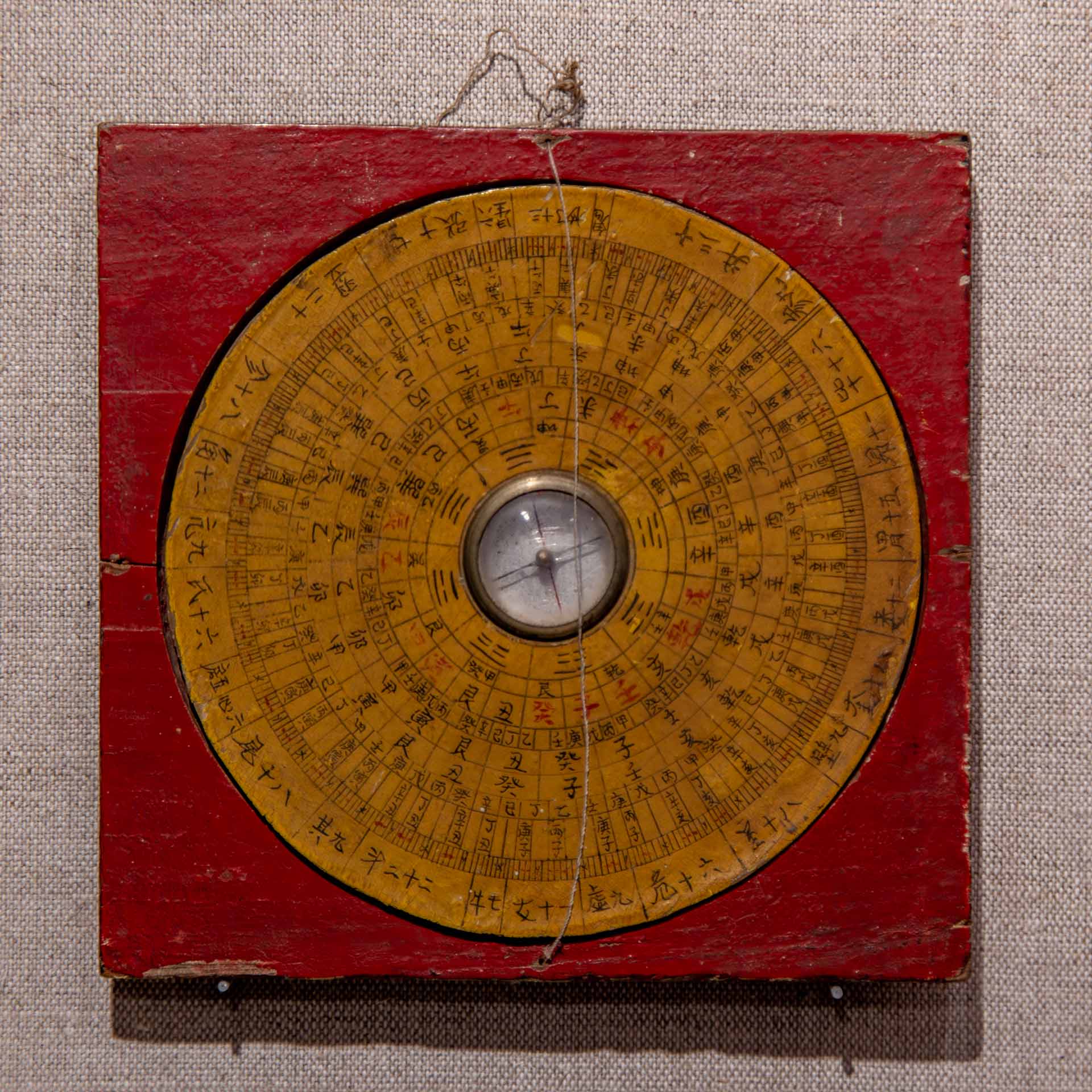
The wooden square base represents the Earth, while the round plate represents the heavens. This is a geometric pattern that frequently appears across Chinese symbology and design. In the center of the device is a South-facing compass. On historical Chinese compasses and luopan, south is positioned at the top.
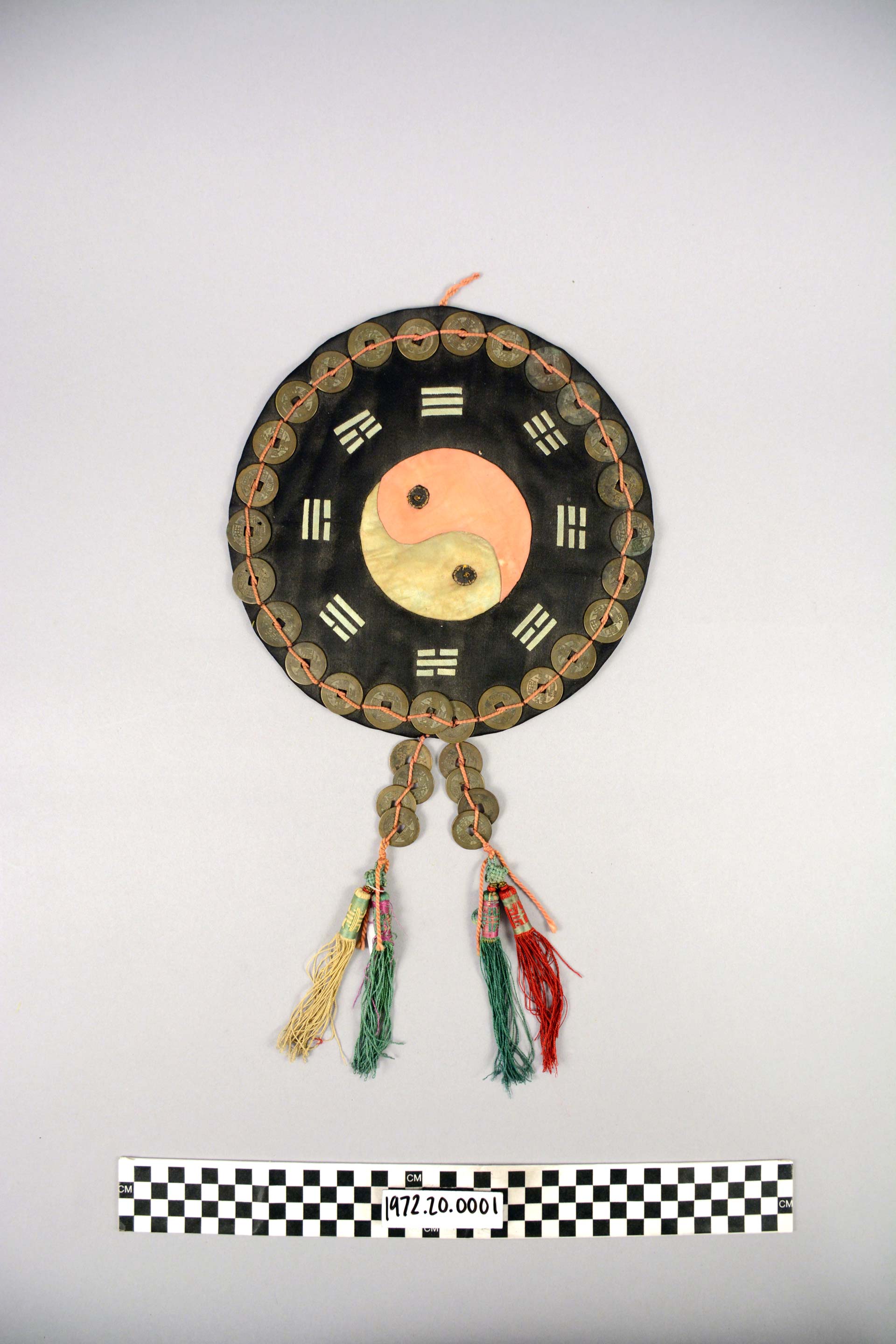
The innermost ring divides the compass according to the Ba Gua (八卦). The Ba Gua can be oriented in two ways. The first is the Early Heaven Sequence, also called the Primordial Ba Gua. This sequence has the Qian (乾) gua oriented south. The second pattern is the Later Heaven Sequence, or Manifested Ba Gua, orienting the Li (离) gua in the south. The primordial sequence is often used to represent the universe as it was originally formed, while the manifested sequence shows how the universe has changed. It is more common to use the Later Heaven Sequence in modern fengshui practice, yet the compass in the Spurlock’s collection is oriented according to the Early Heaven Sequence, or Primordial Ba Gua.
Each Ba Gua is subdivided into the 24 Mountains that each carry additional layers of symbolic meaning, but the primary function is narrow the section from 45° to 15°. The following layers are further subdivided by the 12 Earth Branches (which can also correspond to the lunar year) and the 10 Heavenly Stems. Combining these sequences allows for the identification of specific dates within a 60-year cycle. This is included on the luopan so that practitioners can analyze fengshui based on the age of an individual or site. The luopan is covered in additional rings containing further meaning and interpretation, which is why it often requires professional training to fully understand and utilize a compass.
Personal Practice
Even in areas where masters of fengshui still reside and beliefs about qi remain prevalent, not everybody has the skill, time, or necessity to use a full luopan for every decision. There are many principles that can be applied by anybody to create a more positive environment, even if you are completely inexperienced with fengshui.
Yin and Yang
Yin and yang are opposing concepts that can be overwhelming when they are predominant but create an ideal scenario when balanced. In the home and design this is often expressed as a balance of light and dark, cluttered and sparse, or busy and empty. Adding elements of one to offset the other is how you can create a more balanced space. For example, in a room that is too yang you could lower the temperature or draw the curtains, and in a room that is too yin you could add more plants or paint it a lighter color.
Ba Gua
The Ba Gua, which is included in the luopan, can also be used independently. Each direction fits the ideal conditions for different rooms, emotions, and people. Adjusting the items in a room or layout of a home to fit the Ba Gua can help identify and make use of auspicious and inauspicious directions.
Protection and Guardians
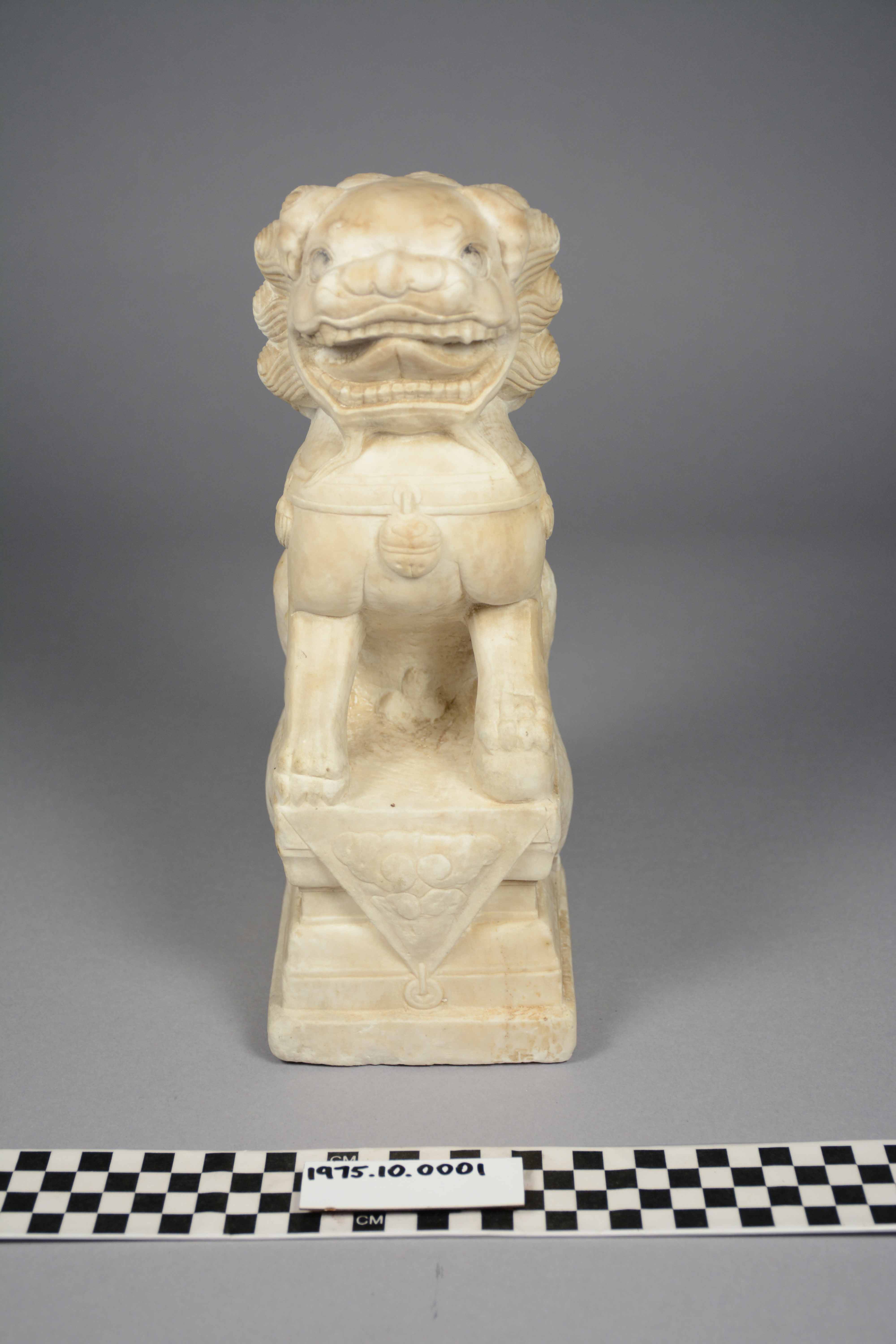
Statues, figures, and features placed at doorways or in important rooms are associated with protection from negative forces. A classic example of this is to place a Fu Dog outside the front door. These guardian lion spirits have protected palaces, temples, and tombs for centuries, and today are often found in front of public and private spaces alike. Pixiu (貔貅) are another example of a guardian animal that is said to improve fengshui and protect individuals or homes. These can be seen in architectural designs as well as jade statues or jewelry.
Natural Features
Inviting natural elements into your home is an excellent way to control the movement of qi or add yang to a space. The presence of different houseplants may increase the presence of yin or yang and are also associated with auspiciousness and fortune. Subtle water features are also very common for improving yin, fortune, and maintaining positive qi in the home.
-
- Share:
- Subscribe to Newletter
- Giving