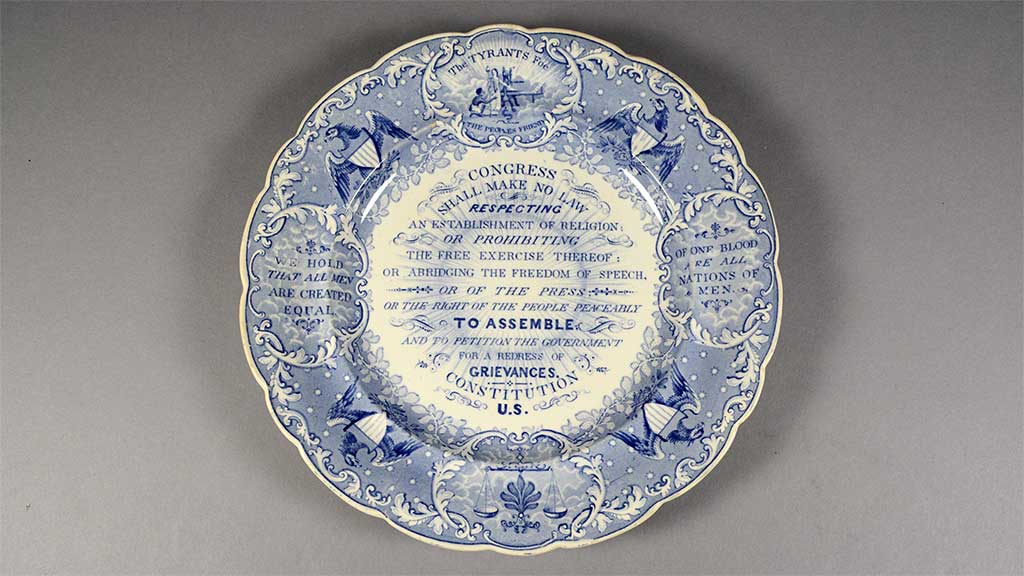
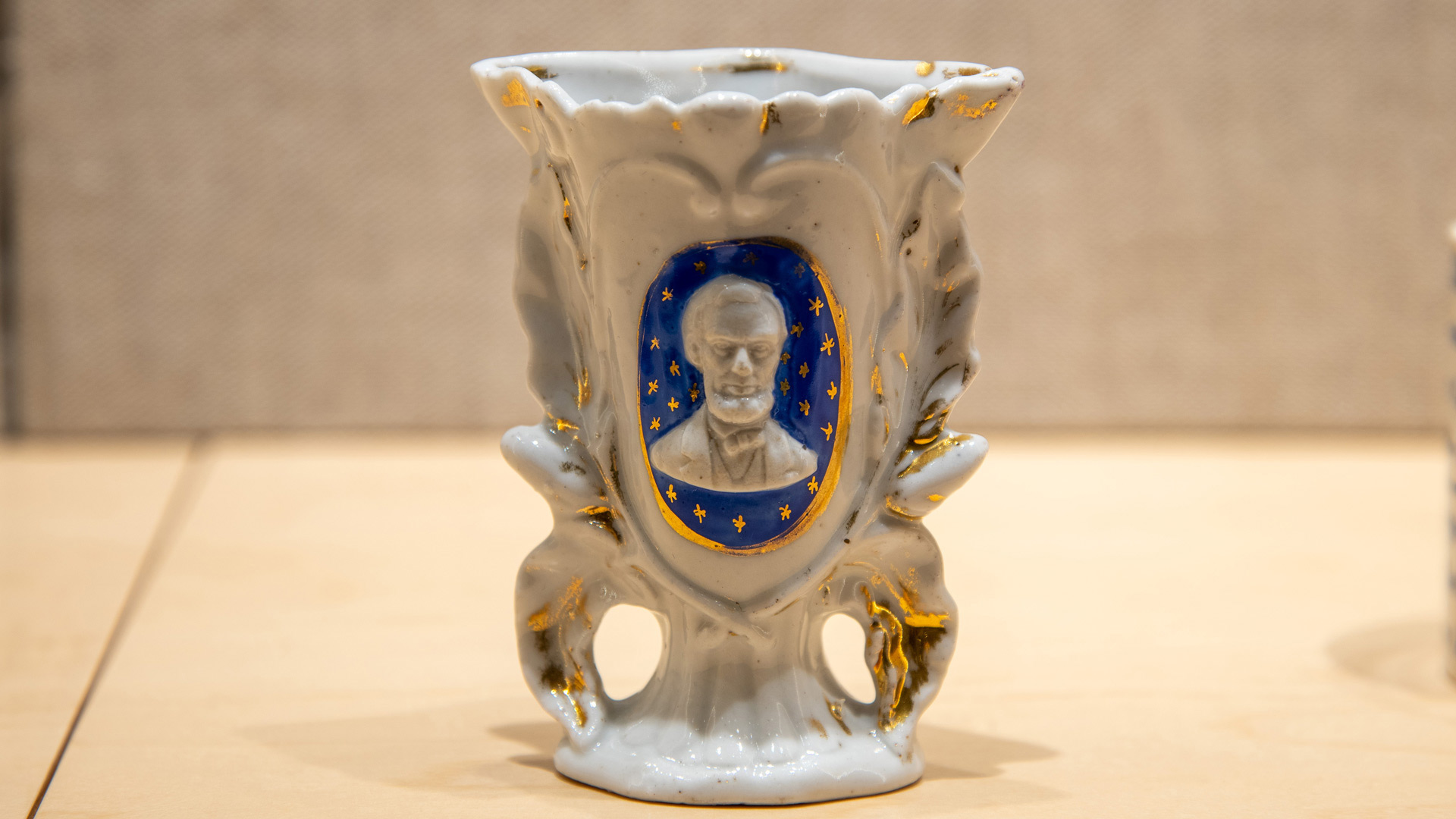
Porcelain Dinnerware: Bringing Campaign Images Home
- Post Date: 7/20/2026
- Author: Norah Harson, registration student assistant
- Reading Time: 13 minute read
In December of 2025, internet rumors began to swirl regarding the golden appliqué embellishment of President Donald Trump’s recently renovated Oval Office. These rumors argued that the swirling golden accents were sourced from the home improvement chain Home Depot, and merely painted gold to fit the President’s gilded aesthetic. The president rejected these claims with conviction, arguing that the appliques were gilded by a Florida craftsman who did the work by hand, according to the New York Times
In this internet discourse, the question arises as to the significance of these decorations. Why does it matter how the White House walls are decorated? Shouldn't the media focus on more important issues such as the economy and international relations? But it could also be argued that stylistic decisions, especially in reference to the presidential seat of power, have a role in communicating the values and beliefs that shape a president's narrative around leadership and diplomacy. Changes to the White House decor may influence public perception by calling upon broader stylistic traditions or purposeful shifts away from them.
These stylistic influences can be seen in other aspects of American life, including our architecture. The United States Capitol appears as a Roman temple with a portico at its entrance, topped by a remarkable dome, and surrounded by colonnades of Corinthian columns, communicating the ethos of republican values associated with Rome. On a much smaller scale, these influences can still be seen as well. Consider this small white vase, with the raised impression of Abraham Lincoln’s portrait. Lincoln is portrayed from the bust up, with his body posed slighyl away from the viewer. Surrounding him is the delicate foliage of olive leaves resembling the decorative embellishments seen in the neoclassical style and light gold embellishments interspersed across the surface of the vase. Together, these qualities hark back to the values of democracy, dignity, and peace.
-
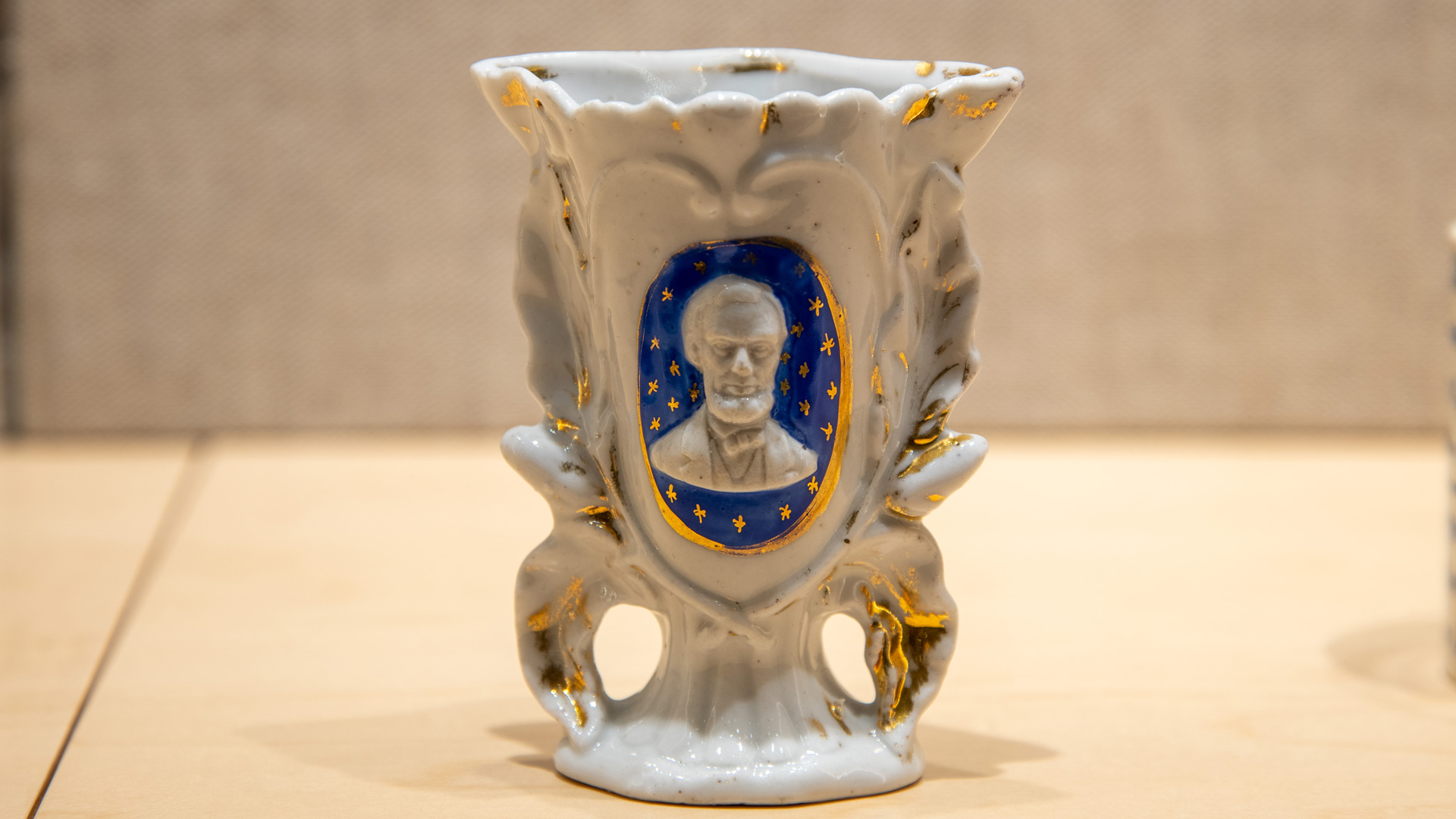 Vase United States ceramic with pigment 1864 The People's Collection, U.S. History and Culture 2017.06.0075
The question remains as to whether or not the United States can be said to have its own particular style. This question is particularly fraught due to the question of a uniquely American stylistic lineage and is particularly fraught due to issues of the nation’s settler colonial existence. This question was first broached in the Revolutionary era, but continues to this day. Arguments over an appropriate American style extend over a vast swath of tastes, including penchants for neoclassicism, realism, and even abstraction. The Spurlock Museum’s People’s Collection, U.S. History, contains objects displaying some of the stylistic changes over time as seen in the history of presidential elections. This article and its accompanying programming will explore the emergence of particular stylistic preferences in the American political landscape, where they came from, and how they were cultivated by particular audiences. Additionally, this article will consider who and what gets left out in these narratives.
A Global Materiality
To narrow the scope of the large People’s Collection, U.S. History, this programming considers ceramic dinnerware in particular. Although ceramics can be colored through a variety of mechanisms, including using colored clay and colored slips, many of the ceramics within this collection have a base color of white, as seen in the pitcher below. To explore this lineage, we must look back all the way to circa 700–221 BCE in Zhejiang, China, when scholars locate the first truly porcelain ceramics.
-
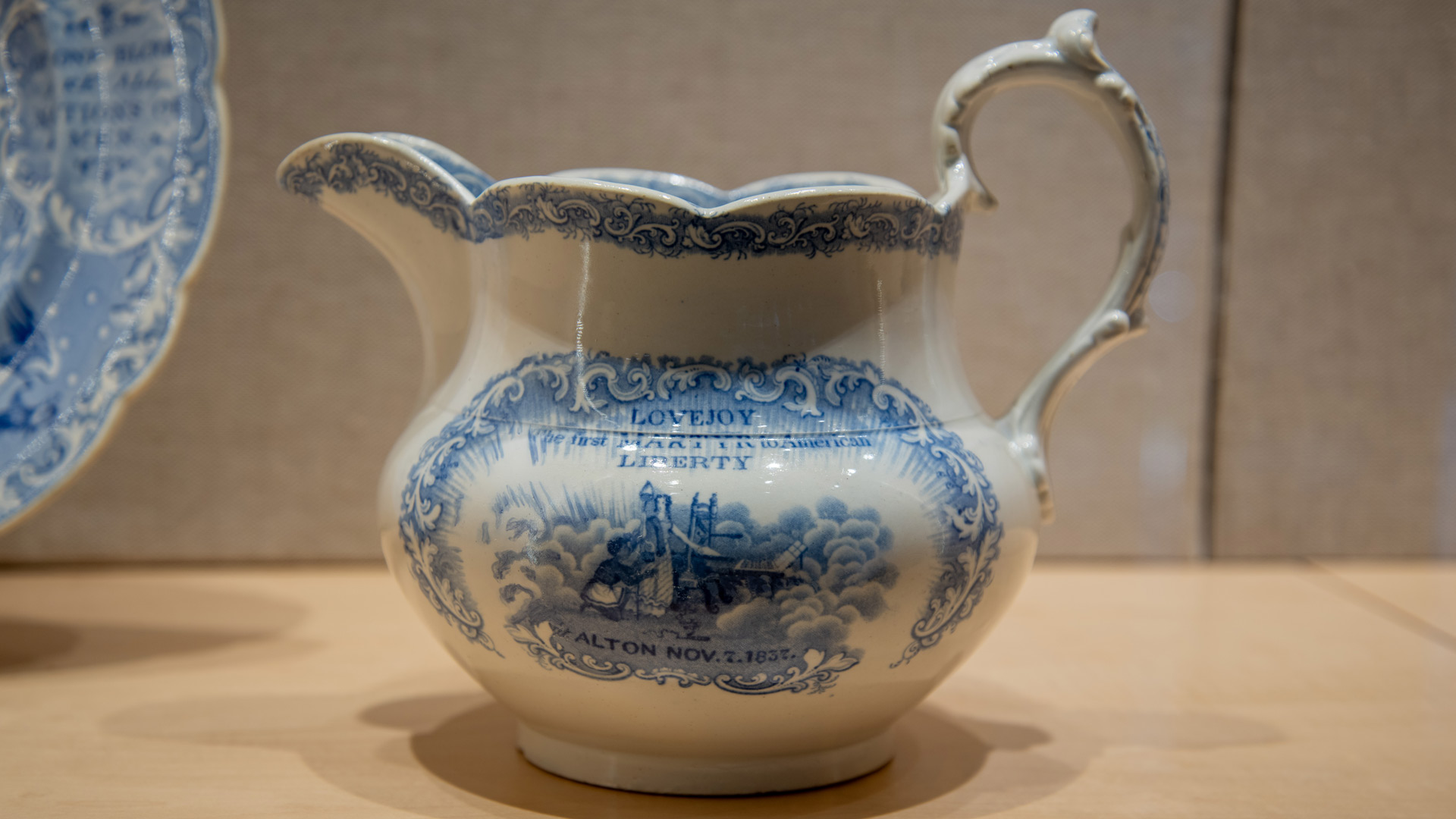 Pitcher: Elijah P. Lovejoy, Martyr United Kingdom ceramic with pigment 1839 CE The People's Collection, U.S. History and Culture 2017.06.0024
This porcelain is a unique ceramic known for its bright white, nearly translucent finish. This occurs when the chemicals within the clay, including kaolin, feldspar, and quartz, undergo extreme heat in the kiln (2,200–2,600°F) in a process called vitrification. This process makes porcelain remarkably hard, and though it can be brittle, provides the material with a surprising degree of durability. The first recorded blue and white examples of porcelain came later from the Tang Dynasty (618–907 CE) and are thought to have used blue pigment sourced through trade networks in Persia. This history precedes the European colonization of the Americas by nearly a millennium. How can such a distant past maintain such a strong influence even to this day?
Europeans likely first came in contact with porcelain when the Portuguese began direct trade with China in the 14th century. However, it was not until the 16th century that the Dutch and Portuguese set up commercial trade routes that a robust export market for porcelain began in Europe. The rarity of porcelain had an intoxicating effect on the European elite, and they paid steep prices for the distinct material, which was not replicable in Europe, as Europeans had yet to discover the secret of kaolin to produce the glassy effect of the material.
European tastes would influence the production of Chinese porcelain, leading to the adaptation of imagery to include what Europeans would consider exotic Chinese and South Asian landscapes.. An example can be seen in the saucer below.
-
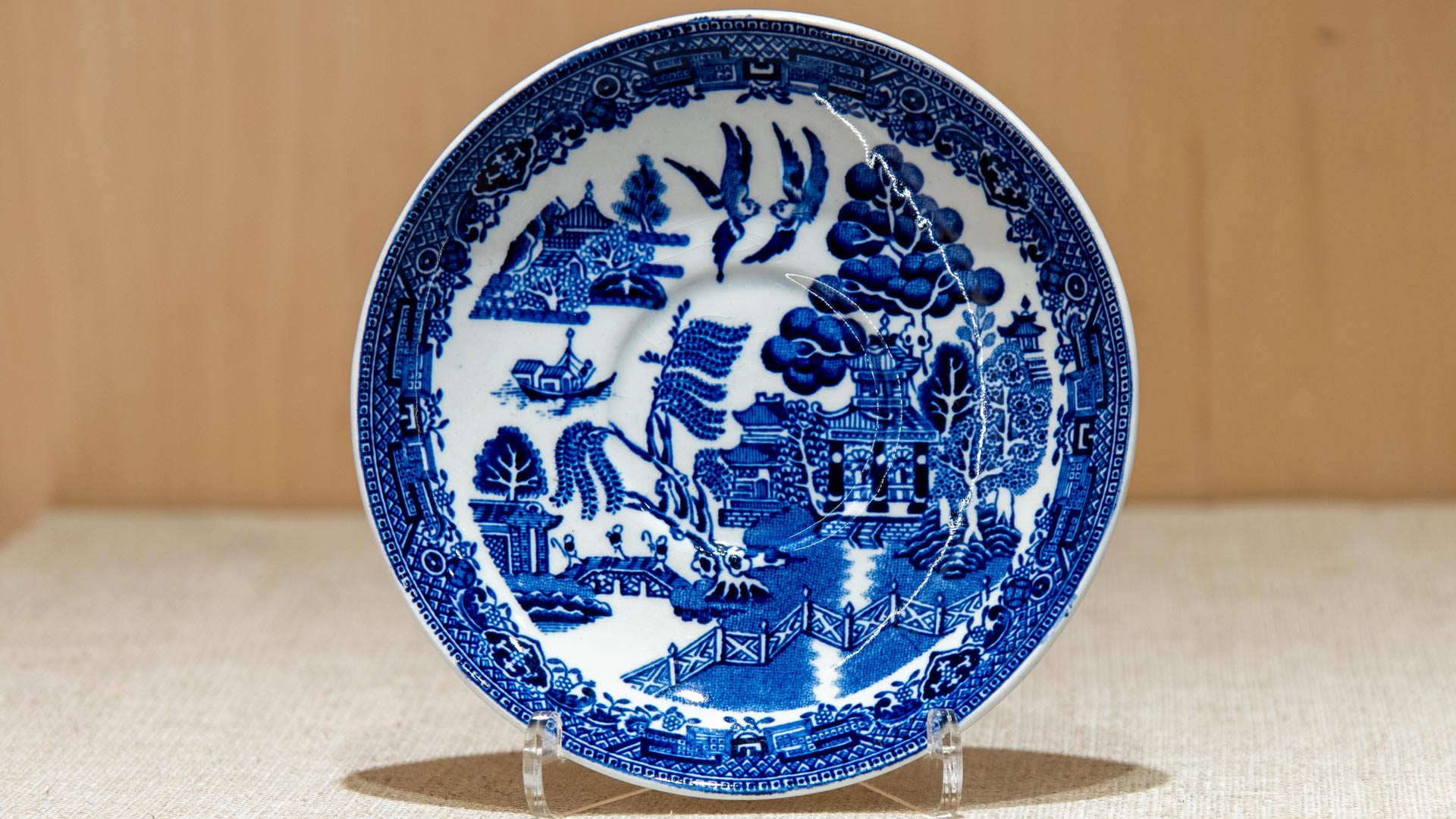 Wood and Sons Saucer by Wood and Sons UK, Great Britain ceramic with pigment 20th century Gift of Harley J. McKee 1968.05.0026A
By the 18th century, Europeans would discover the secret to hard-paste porcelain and begin producing their own porcelain works, but not without continuing the aesthetics adopted from earlier Chinese porcelain. The ability to produce their own porcelain created a much more economical product that could be enjoyed by a broader public. However, centuries of porcelain’s scarcity and exclusivity would permanently associate the material and its aesthetics with an elite lineage of materiality.
-
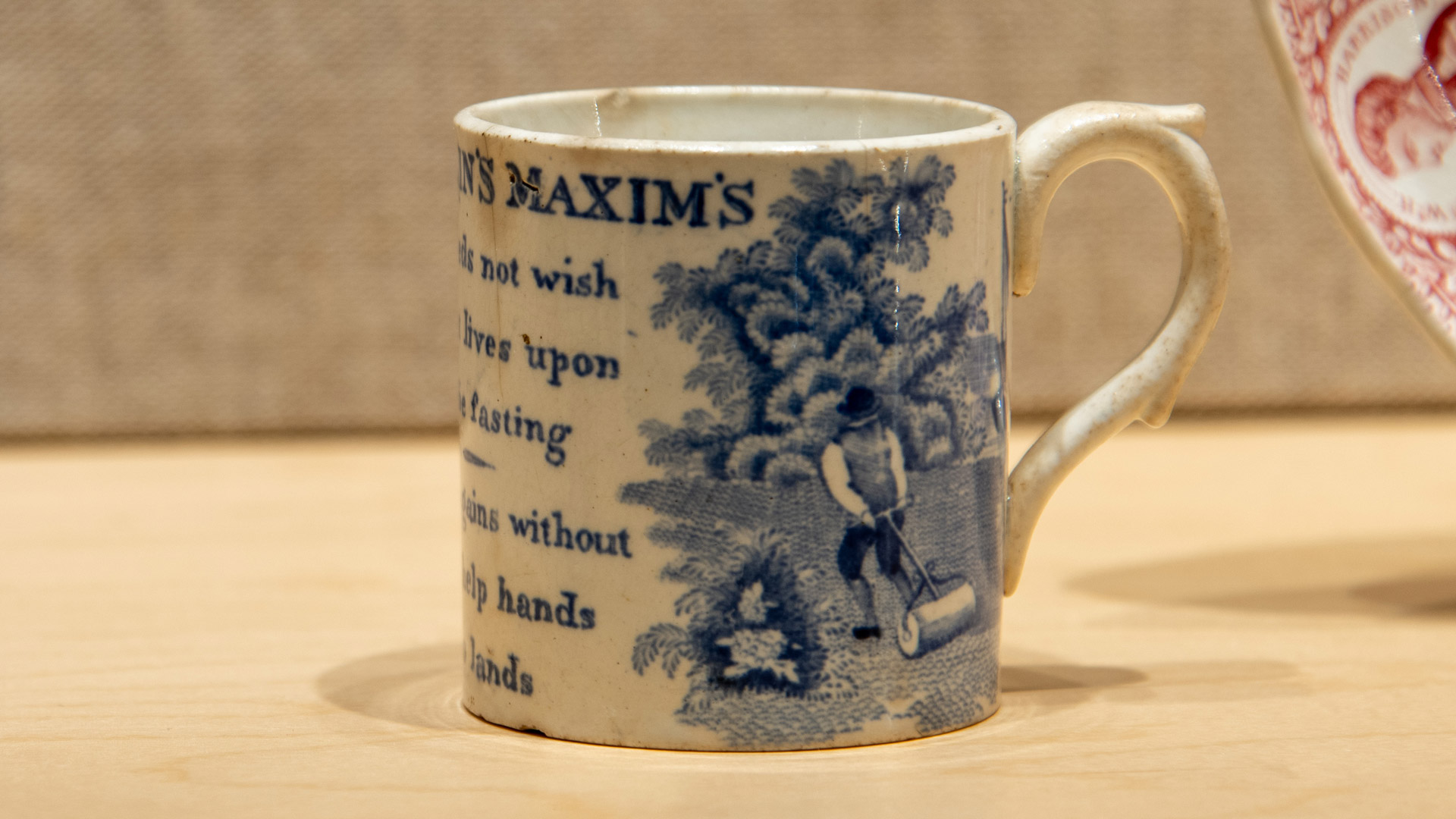 Child's Cup United Kingdom ceramic with pigment 1790 CE The People's Collection, U.S. History and Culture 2017.06.0030
This lineage leads us to porcelain’s role in the American identity. Through trade with England, a dominant European manufacturer of hard-paste porcelain, American colonists began cultivating porcelain collections as a means of elevating their personal status. Following the Revolution, these materials would become a vehicle for important political messaging.
Unabashedly blazoned with the image of a political candidate, political messages would enter the room via the dining table, directing conversation to issues centrally promoted by the candidate. In some instances, this could merely be the figure’s face, as often seen with figures such as George Washington or, later, Abraham Lincoln. For these mythologized icons of American history, their image alone was enough to convey the values of the owner and strike conversation amongst the sitters at the table. For other candidates, however, as seen in the Log Cabin Campaign of William Henry Harrison, a more abstract argument was made. Using imagery of rural American (white) labor. Harrison’s campaign ran on a theology of hard work and American honesty.
-
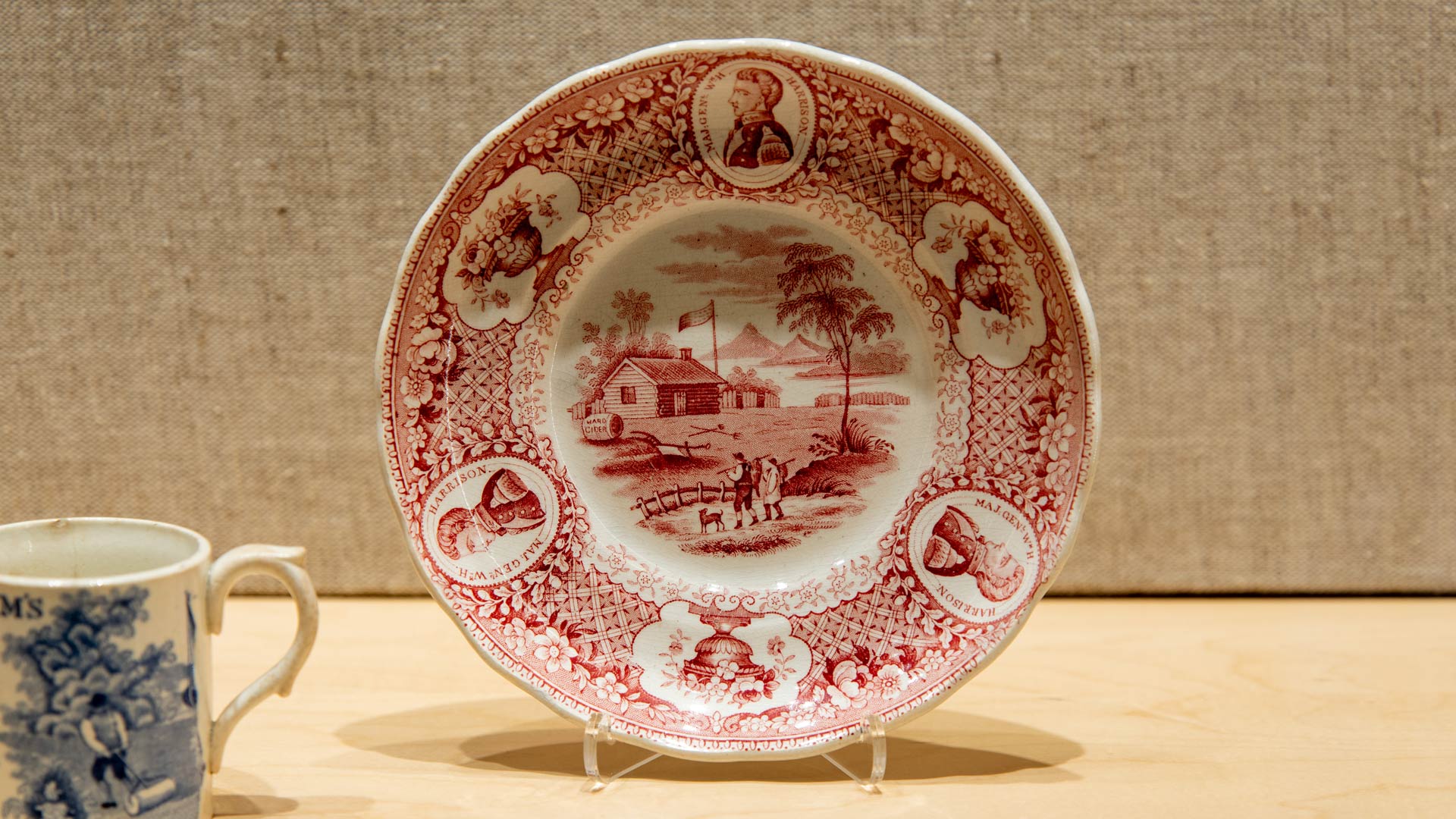 Saucer by William Adams & Sons UK, Straffordshire ceramic with pigment circa 1840 The People's Collection, U.S. History and Culture 2017.06.0060B
Women at the Table
A unique quality of dinnerware is its proximity to the domestic sphere and, therefore, to spaces in which women held significantly more authority when compared to the public spaces such as newspapers and courtrooms. Similarly to how trade with Europeans impacted the way Chinese porcelain artists made their designs, a predominantly female audience also impacted the ways manufacturers, now dominantly English, designed porcelain objects. In the saucer above, the geometric and floral patterns resemble those of textile arts like lacemaking that occupied much of women's labor, especially in the 18th and 19th centuries. These stylistic resonances reflect a deliberate appeal to female consumers, whose purchasing decisions shaped the market for political ceramics.
The role of women in shaping the political conversation around the dinner table deserves particular attention. Historians have described the ideology of "republican motherhood," the early American expectation that women were responsible for instilling civic virtue and patriotic values in the next generation. In this framework, women's domestic authority carried direct political influence where the home was understood as the nursery of the republic, and the objects within it were its curriculum. The dinner table, curated largely by women, became a site of political education.
-
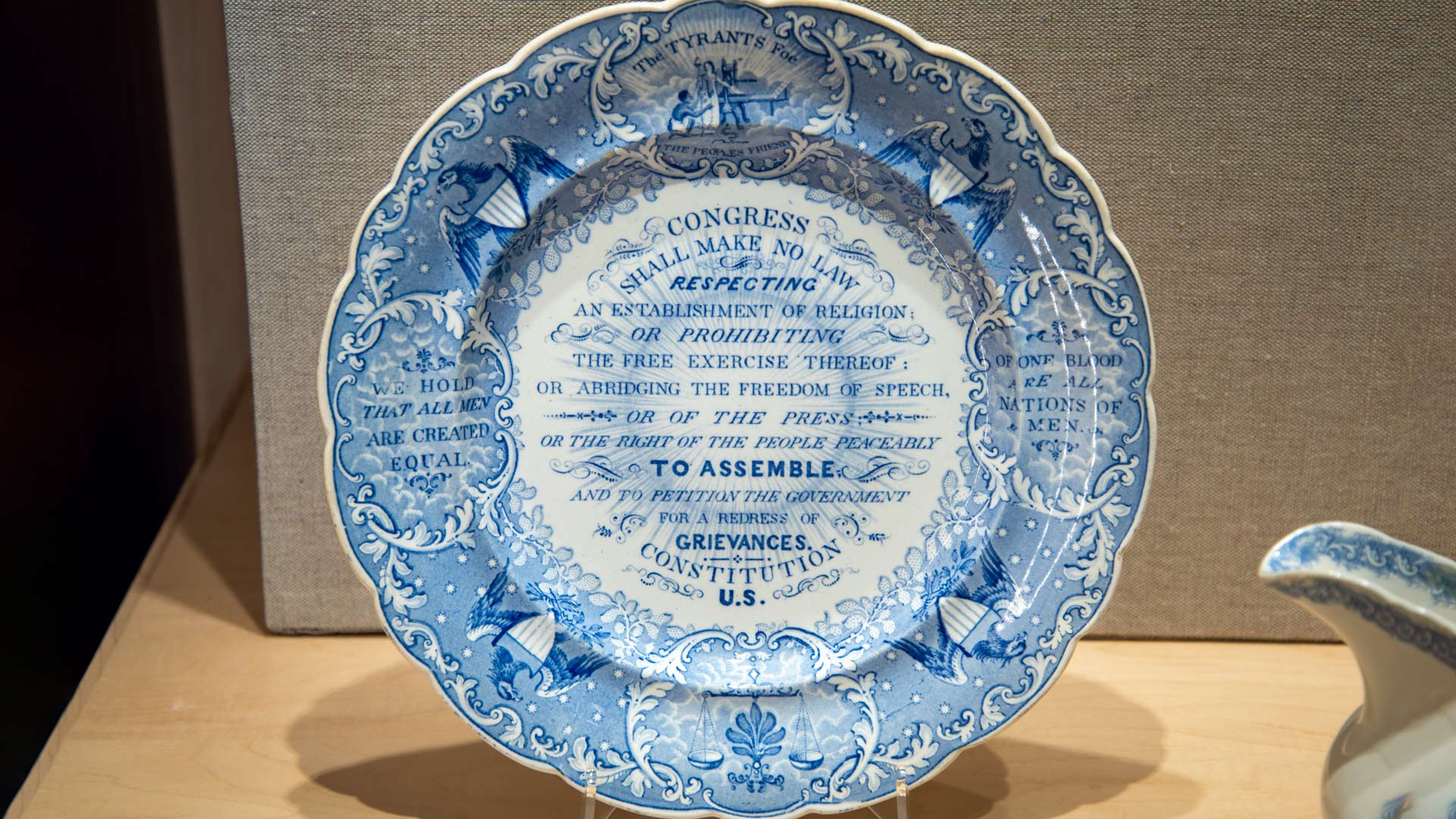 Commemorative Plate: Abolition or Constitution of U.S. John Ridgeway UK, Straffordshire ceramic with pigment 1838-1840 CE The People's Collection, U.S. History and Culture 2017.06.0045
In a political landscape where women held no formal power, the domestic sphere created a unique opportunity to express political conviction. The choice to display a candidate’s portrait on a pitcher or plate was therefore a statement of allegiance made within a space where women maintained considerable influence, even as the candidates represented on those objects were selected and promoted by men. Through these objects, women participated in electoral culture long before they were granted the formal right to vote. The 19th Amendment would not guarantee women's suffrage until 1920, yet women shaped political discourse in their households, in their communities, and through their consumption choices for well over a century prior.
It is equally important to recognize the limits of this participation. The majority of the women whose domestic choices were recorded and preserved, were white and middle to upper class. The porcelain objects themselves encode these exclusions: their associations with European manufacture, elite lineage, and the perception of refined taste reflect a political culture that centered whiteness and property. Enslaved women, working-class women, and women of color were largely denied access to these objects and to the domestic authority they represented, even as their labor maintained the very households in which these objects circulated. The narrative of women's domestic influence in American political culture must consider whose domesticity was legible, valued, and preserved.
Conclusion
Each pitcher, plate, and vase within the Spurlock Museum's People's Collection carries centuries of accumulated meaning, tracing a path from the kilns of Tang Dynasty China through the trading ports of Europe to the dining rooms of the American republic. The whiteness of these wares is not neutral. It carries the weight of colonial aesthetics, elite aspiration, and a particular vision of what American identity should look like.
Political campaign ceramics reveal the complexity of how Americans have understood citizenship and belonging. They show a political culture that operated not only in newspapers and courthouses, but at the dinner table, in the home, in the spaces where women held authority. They display the ambition of a settler colonial nation constructing an identity from borrowed aesthetics, and the persistent effort of ordinary people to make meaning from the objects they chose to bring into their homes. As we approach the 250th anniversary of American independence, these objects invite us to ask whose inheritance is being celebrated, and whose has been left out.
-
- Share:
- Subscribe to Newletter
- Giving